Saturday, November 29, 2008

Real pain

Terrorism is truly the scourge of this decade. It isn't that terrorism started in the new millenium. Back in the 1950s, 60s and 70s, terrorism reigned for various, but largely, non-religious reasons. At least there wasn't a feeling that any major religion was using terror for its ends. Then, reasons for terrorism were politics, nationalism, mafia and money, not in any order of prevalence.

Ever since 911, Islamist terrorism appears to have defined this decade. Even today, towards the end of 2008, and soon, the first decade of the new millenium, Islamist terrorism still wreaks havoc. This last week, India's Mumbai (formerly known as Bombay) suffered its own 911. Having lived through the decade, one is almost numb to these terrrorist acts. First, they killed because US and the UK supported Israel. Today they still do so for the same reason, but in the process, more innocent people of other nationalities have been killed. This week, Singapore suffered its first casualty of this madness. A young lawyer, only 28, was reportedly killed by Islamist terrorists in the Oberoi Hotel, Mumbai. Her body was found on the 19th floor of that building. Ms Lo Hwei Yen, the lawyer, was in Mumbai on assignment.

What more can we say that has not already been said about the cruelty, the indiscriminate, no, the madness of these killers? That's what they really are. Not martyrs, not by any means religious, not god-loving, not compassionate, not human and most of all, not Islamic. They say that their martyrdom will usher them into heaven. Why then are their leaders still living? To send even more naive Muslims on their way to heaven? Utterly ridiculous but painfully real. Sadly, there are probably many closet terrrorists, Muslims who quietly applaud such acts, but who appear to be god-fearing and law-abiding. Is this why Islamist terrorism cannot seem to be defeated?

This blog writer would like to express his condolences to the family of Ms Lo, a fellow Singaporean.

As for the these terrorists and those in the closet, may they never rest in peace. May they rot in hell, forever.

Half a century of terrorism, and counting ... Terrorism 1951-1960 ... Terrorism 1961-1970 ... Terrorism 1971-1980 ... Terrorism 1981-1990 ... Terrorism 1991-2000 ... Terrorism 2000-2010


Image: morgueFile.com. Author: Eleanor & Will

Friday, November 28, 2008

Best is less

The Singapore National Library (NLB) is a great institution. Over the years, it has grown from strength to strength. Its decision to site its branches in busy shopping malls was an inspired move that has brought its books literally closer to a wider reading public. There is much to say for this institution, which services remain free of charge.

But I was choked when I read its READ! Singapore 2009 campaign. It isn't a new idea, but its still a great campaign, except when it asks the public to "recommend their favourite inspirational books to be promoted for nation-wide reading during READ! Singapore 2009" (http://tinyurl.com/6lq97m). It then goes on to stipulate that the recommendation must be an international bestseller or an award-winning title which length is "between 50,000 to 75,000 words (less than 380 pages), and should reflect the theme of READ! Singapore 2009".

To start off with, these conditions do not exactly inspire. If the NLB wants international bestsellers, it can just go up the already published popularity/recommenation list from publishers, book reviews, etc, which are readily available. Why get recommendations from readers? These bestseller lists are a result of public 'voting' through their purchases. If it is an award-winning book, well, there aren't that many awards anyway (if there were, the awards become dubious). With only a handful, what's there to exclude? My point is, what is the point of recommending what has essentially been recommended? Isn't it a waste of time? Further, the restrictive conditions prevent people from recommending a book they have read and were genuinely inspired by notwithstanding that it is not an international bestseller or award-winning book. These are called gems which are not easily found and may have missed the popularity stakes. Not all bestsellers are, after all, inspiring. Some of them are 'engineered' to be bestsellers for wholly commercial reasons.

I think, in this instance, the NLB has mis-directed the public, which is a shame.

Image: morgueFile.com. Author: Clara Natoli

Wednesday, November 26, 2008

Follow the porridge

Why am I underwhelmed to hear of the government ministers and top civil servants taking huge pay cuts next year? That is because the rich, people earning a million dollars and upwards a year, can afford to lose a couple of hundred thousands of dollars any time. It will not affect their day-to-day expenses - nobody needs to start eating beans and porridge instead of the power breakfasts, power lunches and power dinners. I would also surmise that it wouldn't affect whatever downpayments they may have on the house they live in, nor would it upset the family budget in any significant way.

While I acknowledge PM Lee Hsien Loong's gesture that he will donate his increments to charity for the next 5 years (demonstrating that he doesn't need the money, anyway), his Ministers are not in any practical way less well-off after the 19% cut.

On the other hand, why am I worried? If this signals to employers to cut people's pay, then hardships may be the order of the day. If I earned $3,000 and I get even a 10% pay cut, and I have 2 kids and my wife just lost her job, that may drive me to eating beans and porridge for breakfast, lunch and dinner, or maybe even skip a meal, which will be detrimental to my health. We all know that we can bear with the beans and porridge, but we just cannot afford to be hospitalised. Not in Singapore, not ever. That'll kill whatever savings we may have, savings that are suppose to tide us over the next few years of 'famine'. Yes, the Health Minister has promised that he will be compassionate as far as the bills are concerned, but that'll turn us all into beggars of sorts (begging the hospital to waive the high charges, i.e.) wouldn't it? You wonder if we have made any progress in the last 40 years or so where healthcare costs are concerned.

And what about all those monthly payments for the housing loan, which is likely taken from my CPF account. My monthly contributions to that CPF account will be reduced together with the pay cut. Do I have to fork out extra cash every month? The alternative, of course, is to sell the house and downgrade. But in these depressing times, selling the house will be the last resort. You don't want your house to be someone else's discount opportunity of a lifetime.

Already, DBS is playing follow the leader. I am not sure that this leadership by example is an example which all of us salaryman and woman want our bosses to follow, nor can afford for them to follow.


Image: morgueFile.com. Author: Orchid

Sunday, November 23, 2008

Stand Up for Singaporeans

Mr Tan Kin Lian, erstwhile CEO of NTUC Income for 30 years, says he will consider standing for election for the office of President of Singapore or an independent MP. I think many in Singapore have been waiting for him to say this, but Mr Tan says he will only proceed if 100,000 Singaporeans (i.e. eligible voters?) say they want him to stand.

I have suggested this in an earlier blog entry, that he should run for Parliament. I didn't know whether he would, if he did so, run under the PAP or one of the Opposition Parties. I thought the Mr Tan would have more sense than throw in his lot with the likes of Mr Chee Soon Juan, so it would make sense if he joined Mr Low Thia Kiang's Workers' Party since he has left the PAP. But now that he has indicated that he will run as an independent, there are only so many single-seat wards available in Singapore. With all due respect to Mr Chiam See Tong, who may still have the will but perhaps not the strength to continue serving his constituents in Potong Pasir as MP, he should pass the baton on to Mr Tan Kin Lian.

There has always been the question: what next after Mr Chiam, who has stood alone for Potong Pasir as MP for 24 years now? Would the PAP just 'walk' in to re-claim the ward, just like that? Of course the PAP candidates have been gaining ground on Mr Chiam in the last two GE, so it isn't like there are no supporters for the PAP in Potong Pasir. But if the PAP were to regain control, then it would be a loss to Singapore for independent voices. Sure, Mr Low would try his level best to prevent that, but he may not have the right person on the ground in Potong Pasir to mount a credible challenge. Remember that the PAP has been working the ground for some time now, if only to nurse a sore thumb that never seem to be healed. So who better to stand in Potong Pasir than the independent Mr Tan Kin Lian?

Like Mr Barack Obama, Mr Tan is internet savvy. I hear that he is quite good in IT too. Like Barack Obama, Mr Tan represents a fresh voice for the people. But I think the most important thing is that he cares to speak out for the people. This is what Parliament needs more of.

If Mr Tan want's endorsement, he has got mine. But of course you cannot rely on an anonymous name for endorsement. So let Mr Tan put up a platform to collect this endorsement and I will put my real name down. Of course I cannot promise to move house to Potong Pasir to give him my vote, nor can I prevent the PAP government in redrawing the electoral boundaries, but he has my encouragement, however much that is of value to him.

How about it, Mr Tan?


Image: morgueFile.com. Author: Nicolas Raymond

Friday, November 21, 2008

Shifting sands

"Sands said that it had also received word from the Casino Regulatory Authority of Singapore that it had approved the company's proposed casino floor plan for up to 1,000 gaming tables, instead of the originally planned 600 tables."
Straits Times, 8 November 2008

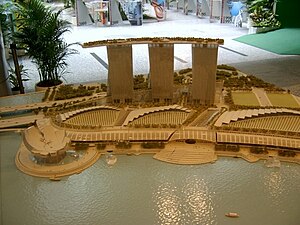
This news refers to the casino being built in Singapore on the Marina Bay. When it was first proposed, there was a huge outcry by many Singaporeans against it. Even the Government Cabinet was reportedly divided. But it was finally approved for the long term good of the economy. The stated intent was to grow the tourism and business meetings sector of the economy in the light of competition from places like Australia, Macau and possibly the Philippines. Something was needed to attract more people to the island. Citing the Chinese as "inverterate gamblers", the Minister Mentor Lee Kuan Yew, who for decades said 'no' to a casino on the island, also relented. Why? Because this development was not about a casino, it was about an Integrated Resort (IR) and the casino was but one of the many facilities that international travellers, company executives and fun seekers could look forward to. That is why, up until now, the development is never referred to as the Marina Bay Casino (not a bad sounding name, actually), but (euphemistically) the Marina IR.

Now, a financially strapped LV Sands has asked for two things. The first is to increase the number of gaming tables from 600 to a whopping 1000, representing a 66% increase over the original. The second is to open the IR in phases, though it did not indicate which part of the IR it would want to open first. If I read their thoughts correctly, they would probably propose to the government to open their casino first. Why? Simply because that is potentially the single (if not only) most profitable attraction in the IR right now. With disappearing conventions, corporate meetings and the like (I was with some traveling industry executives yesterday, and they all told me that they are having to chase down leads and not wait for orders to roll in, as before).

There is a Chinese saying, "Hard times reveals true intentions". In this case, the true intent of the IR is no more about operating a casino. It is the only intent. The other resort facilities, the places for meetings and conventions? Well, they are really distractions, sideshows at best, aren't they? Some would even say they are the excuses, the smokescreen, to hide the real intent of setting up a gambling den - all prim and proper, blessed by the government. Ditto for the Universal Studio Theme Park in the Sentosa IR. They wouldn't make a cent in the current economic downturn. That is probably why the Casino Regulatory Authority of Singapore authorised the 400 more gaming tables. And don't bet against the casino opening second. It'll be the first. Now I wonder if the $100 fee for entry into the casino for locals will not be reduced, or even lifted altogether.

After all, desperate times demand true action.

Image: morgueFile.com. Author:Kevin Rosseel

Thursday, November 20, 2008

Hazydous act

Hazing (pronounced hae'zing) - the juvenile act of subjecting a person, male on male, female on female, from simple to extreme pain, discomfort and humiliation, though avoiding the possible loss of life or limp. Popular amongst students, from Secondary Schools to Tertiary Institutions, particularly elite schools such as Anglo-Chinese Junior College (ACJC), the act avoids sex but can be sado-masochistic in nature for the very fact that torturer and toturee are willing parties to the act and both apparently enjoy it. It is recognised by some authority figures that the boys and girls are just having a bit of fun.

Highly controversial act, which gives it its popularity among juveniles and some adults.

View a sample video of Hazing

Wednesday, November 19, 2008

The Sunk Fund

Wow! 12 big fat ones, all gone. I am, of course, referring to the report in Parliament yesterday that two of our Town Councils (TCs), both helmed by PAP government MPs, have lost $12 million dollars of the people's money - held as the sinking (no pun intended) fund for the purpose of repairing and improving the common properties in and around the residential estates - by investing that money in the very risky Lehman structured financial products.

The government, to its credit, disclosed these losses in Parliament yesterday, saying that these losses represented 6% and 2% of the sinking fund of these TCs respectively, but that these TCs remain in the black. Well, black, red or white is not the issue here. The issue is that a substantial amount of the people's money, kept in trust, to be used for the people, have vanished into thin air. And the shocking thing this, nobody is standing out to take responsibility for it. Everybody is hiding behind Parliamentary disclosures, announcements and, it would appear, exoneration. No, we don't want to go witch-hunting, but we want accountability. No we don't want to sack anyone, but we want, perhaps, some contrition and admission of wrong by some parties. All that I am hearing now is that the town councils will now adopt a more conservative investment strategy - itself a tacit admission that they were wrong in investing in these highly risky products in the first place, but nothing more. Maybe instead of lambasting and ridiculing the opposition the next time, the PAP MPs and government should take a leaf out of them this time. Hindsight is always a better teacher because we can see with perfect vision what we should and what we should not have done. If the town councils involved - Holland-Bukit Panjang and Pasir-Punggol, who respectively lost $8M and $4M - had that vision BEFORE the event, they wouldn't now have ended with mud on their faces today. Some have made the point that sinking funds are exactly that - stashed away, sunk in a hole, sealed up in very safe fixed deposits. But no, somebody figured that structured products made more money and, without understanding the product, went to market and bought $12million dollars worth of it. When it is not your money, or when you feel that you have 'earned' it through positive investments in the past, the decision to take on riskier investments seem easier. But it is still the people's money, no matter if they are accumulated surpluses or however well one has invested it in the past. All investment gains still accrue to the people's account, just as the losses do now.

Residents now have $12million less to help improve their lives. They have$12million less to cut the fees that they are paying monthly. They have $12million less to put in the bank that will at least earn some more interest. Even at 1% annual interest in an FD account, it will still net $120,000 a year. Sure, its peanuts (now where did this word last cause an uproar?) when you consider the cost of maintaining not one town, but several, but it is money that belongs to the people. Singapore has always prided itself on accountability of public funds. Is it now being conveniently swept under the carpet?

Many in Singapore feel that, with government MPs behind them in their constituency, they can only gain - they stood to stand in the front of the queue for more and newer amenities as well as upgrading works - so people vote for them. But it appears that they also had their money gambled away by the local government, which inextricably, had a huge appetite for risks - risking other people's money, i.e. Obviously they cannot take their grievances now to Mr Tan Kin Lian. The only thing the TCs can do is hang their heads down in shame the next time they ask for more money for the S&C fees. I don't know if they would die of embarrassment. The only way they can demand increases in the fees is if they changed the entire team who lost all those money. For that, we will probably need a GE, which we are told is not on the cards yet.

The constituents, lost big this time around without even stepping into a casino. Will the government reimburse the TCs? Nope, that's not what its going to do, that's not their style, which is well and good. The TCs have to make up their shortfalls - or is there any shortfall to be made up for in the first place. It appears not.

Which disturbs me.

If the loss of $12M is of no consequence to these TCs at all, then what is it doing with so much excess money - money which it still collects from the people every month, money which belongs to the people? The question is - are the people paying too much already in Service and Conservancy fees in the first place? Have they been paying so much over the years that the TCs have found in its kitty sums of money which it can afford to lose? For the sake of the people, I hope not.

Image source: morgueFile.com. Author: Dawn M Turner

Saturday, November 08, 2008

As the sun sets

One of the things about growing old is, as many middle-aged person realise, is that many faculties begin to fail. Not only that, some faculties are probably never going to be restored, like your tooth. Once an adult tooth is lost, it is lost. Of course there are dentures to cover up for the awful look otherwise, but dentures are still not the real thing.

What else fails?

The eyes for another. You may have 20/20 vision all your life, but when you hit the big 4-O, you discover how necessary reading glasses become, especially in the light of the night. Then your language also begins to fail. Where once you could have been a spelling bee, you struggle increasingly to remember how to put together a word - that erstwhile ability to spell anything deserts you.

And don't many of us find our legs failing us, even at the relatively 'young' age of 42. Suddenly, Glucosamine is more familiar to you than Panadol or even Vitamin C. Your hair also becomes perceptibly thinner at the top. Your scalp is more visible at the top although your beard and nostril hair never seem to stop growing.

Of course, you look rougher by the months. Ever deeper lines appear on your face as your hand look shinier by the year, not because of the lotions you might have applied, but that's how aging skin seem to look. You also notice black spots appearning on your face and hands and arms. No, that's not the black plague, its just cells dying.

Worst of all, your memories also begin to fail. What happened last year this time, or 3 months ago, or even 2 weeks ago. You struggle to remember and are dismayed that that part of your life is not history, but an emptiness, an inexistence that eludes you, perhaps forever now.

All these gets progressively worse. Yes, modern medicine can mitigate a lot of the ill-effects of aging. Just look at the roaring business that personal care shops such as Watsons, Guardian and the Body Shop, and even Spas and Gyms do and you realise that you are in the wrong business otherwise.

But that curative ability of modern medicine becomes a problem eventually, when medicine is used to prop one up at the gates of heaven (or hell, whichever the case may be). Advanced Medical Directives (AMD), Euthansia, these controversial terms, take on real meaning. Did you remember to let your loved ones know how you prefer to be treated, when you have lost all your communications faculties? Would you have preferred that your loved ones stop wasting expensive medicine just so that you can continue lying on a bed, doing not much more than being fed through a plastic tube? Or worst, when you, an adult, begin to behave no differently from a baby, remembering nothing, no one, and defecating anywhere and everywhere because, like a child, you have lost all control of your bowel movements and your sense of shame. You cannot instruct anyone to kill you because death is no longer in your vocabulary.

Can someone do you in, legally, since you no longer know better, and probably would have preferred it? The answer is simple, isn't it? Or is it?

Image source: morgueFile.com. Author: Mary Thorman

Thursday, October 30, 2008

Toxic Towns

News about the Lehman bonds never ends, it seems. Now, it has been reported that PAP-controlled Town Councils are exposed to the Lehman bonds. The officials, people of the PAP government are trying to make light of this fact, saying that the exposure is not significant, that "only a small percentage of their total investments were spent on those affected products" (Yahoo News). Words such as "minimal", "no fear that....the funds will be wiped out...", "guarantees the principal amount..." are being trotted out to control the damage from this situation. On the other hand, Potong Pasir and Hougang, whose Town Councils are under Opposition control, reports that their investments are safe from these toxic investments, as they are either in government bonds or fixed deposits. A very wise, prudent and truly conservative approach to investing the people's money.

Now, if the situation were the other way around, wouldn't the PAP government hammer the Opposition for being irresponsible, reckless, nonchalant, financial fools, etc? Yet the fact is that it is the PAP-controlled TCs that are the ones deserving of these words. They are right - the TC sinking funds belong to the people in the town they manage. But they are wrong when they seem to imply that the losses are insignificant, for, to every citizen, every cent must be accounted for. Perhaps it is timely for these TCs who have invested and lost in the Lehman products to account for the investment in full - how much were purchased, what is the extent of their exposure, and what they potentially have lost. I suppose that TCs do not fall in the bracket of the old (i.e. > 62 years old) nor the ignorant, that instead, the banks will consider them as 'savvy' investors. Which means that they stand to lose the entire investment.

It is necesssary for the affected TCs to give a clear account and not sweep the losses under sweet words.

Image source: morgueFile.com. Author: Gracey

Tuesday, October 28, 2008

Dicey Business

The other day, I had lunch with a friend. We don't meet up often, but when we do, we have lots to say. In this case, the first order of conversation was the doom and gloom in the markets and the likely effects of the recession. You see, both of us studied Economics when we were in the University together many years ago. Naturally, the conversation steered its way to the recent Lehman Minibond debacle, occasioned by the collapse of Lehman Brothers in the US.

In his opinion, everyone, from the old and ignorant to the savvy investor who may have several degrees, should be compensated in full because these structured investments were mis-sold to one and all. Why so? Because when a person with a PhD (not in Finance, though in Business and Information System) could make a little sense of these financial products and write about it, he still expressed a caveat - he couldn't be sure that what he understood and wrote about the Lehman structured products was complete or correct. (in Singapore's Sunday Times, 26 Oct 08).

Did the Customer Relationship people understand the products they were selling? Absolutely not. Did their managers understand what they were instructing their subordinates to sell? Highly unlikely. They weren't academics who would want to understand the products. They were just salesmen. Did the senior management understand the products they undertook to retail? Perhaps, but if they did, they are no less culpable. Why? Because they knowingly sold toxic assets. How can anyone sell poison, like the toxic milk powder from China, and yet remain blameless?

Well, ok, I am not being fair. The senior management probably understood the risks underlying these products. But never in their wildest dreams did they see the collapse of Lehman Brothers, the venerable Investment Bank that started life in the 1840s. But were the risks adequately explained to the investor, young, old or savvy? I doubt so. And if it wasn't, then there has been a mis-selling of the product, so insisted my friend. Therefore, the banks must compensate one and all without reserve. I said that that is very unlikely, but he remained adamant.

Such are the emotions that inevitably follows the possession or dis-possession of wealth. My mother, who is past 80, was worried that a sum of money she was coaxed into investing several years ago may have been the Lehman bonds. She couldn't sleep well for 2 days and only upon further enquiries could she be assured that it had nothing to do with the now dirty word "Lehman". And the takeaway lesson? When you don't have money, you worry. When you have money, especially when it is a lifetime of savings, you worry more. Truly King Solomon was right when he wrote, 'Vanity of vanities, all is vanity! What is the profit to a man in all his labor which he labors under the sun? " (Ecclesiastes 1:2-3)

P.S. I suppose it has dawned on everyone that the Financial industry in the last few years, those that dealt with sophisticated products in particular, was no less than a worldwide betting syndicate involving sophisticated high-rollers and your mom-and-pop 'gamblers' betting on higly sophisticated financial products. The only difference is, it is legal, highly respectable (till recently, that is), and, more importantly, clueless to many. They just didn't understand what they were putting their money on. Why then do we need a casino, and two at that?

Image source: morgueFile.com. Author: Jane M Sawyer

Tuesday, October 21, 2008

10,000 duds?

I never cease to wonder at the optimism that Singapore, or more precisely, the people who are in the tourism business seem to display, even in these recessionary times. Mr George Tanasijevich, GM and VP of Singapore Development, Marina Bay Sands Resort (aka the Marina Integrated Resort), wants 10,000 line workers (see also Today Online) to staff his brand new Resort, which is slated to be opened in late 2009. This has given a boost to the morale of the Singapore workforce, and even the Singapore government in these bad economic times. Minister Lim Hng Kiang even went so far as to say that the economy will see recovery in 2 years' time when the IRs are ready. That's a fantastic instance of crystal-ball gazing, but I guess the government has an army of analysts who can make such predictions, and more importantly, realise them. They have both prophets and Gods on their side. How wrong can they be?

I hope that he is right. I am not so optimistic, though. There seems to be an underlying assumption, even at the highest levels of government, that "if we build it, they will come". I am of course referring to the Marina and Sentosa IRs. With the world slipping into the worst recession in 70 years (someone made the calculation back to the Great Depression of the 1930s and early 40s), and with the worldwide stock markets losing near half of their values at their peak, many people's income and investments have taken a direct hit. Coupled with inflation, everybody, except the poor, have become substantially poorer. (You see, the poor have nothing to lose, so they cannot become poorer). Even business travel is going the budget route, via low-cost airlines rather than the full-service ones. Businesses are reluctant to expand, as banks become more guarded in lending. I would have thought that in such an environment, the first businesses that will be hit are the leisure and entertainment business. Businesses may continue to organise events and conferences (hey, you need to drum up businesses when there is none, right?), but the extra expenses, extra stays, the leisure and entertainment part will likely be cut back drastically. You'd probably witness more fly swatting than finger massages. How long this state of affairs will continue no one is predicting exactly nor can do so with any sense of reality. Many are already saying that it will be a long winter. Some are still in dreamland.

So I wonder if the rosy predictions about the tourism in 2 years' time is warranted at all. Why exactly 2 years? Because that's when the 2 IRs will have become fully operationalised - assuming that the Marina IR and LV Sands haven't folded by then. Already, we are getting not-so-rosy news out of Las Vegas that LV Sands may be facing a credit crunch. Its resort and gambling businesses in Macau have also reported poorer results.

On the other hand, some smart people are arguing that the Marina and Sentosa IR will not be allowed to fail because they are Singapore government initiatives. What does this mean? That the government will be forced to throw good money, taxpayers' money no less, into bad investments, like what the US has done? We are talking S$5billion or more here. I hope we do not end up with white elephants again, the last of which were spotted near an MRT station in the North-east of Singapore. If it is does appear, it will be far larger than the ones we have seen.

The thought makes me shudder.

Image source: http://en.wikipedia.org/

Monday, October 20, 2008

How the Markets really work

Someone passed me this Youtube video that explained in plain man's English (ok, it souds like the Queen's English) what happened in the world of high finance in 2007.

It says a lot about how we ended up where we are today. When there are no good news, we just have to swallow the bitter pill, laugh at the taste and promise not to trust anyone with the title, MBA (Finance/Investments/Risks), after their names anymore, particularly if the word 'bank' appears somewhere as well.

Sunday, October 19, 2008

Toxic times

These are trying times in Singapore for some 10,000 people. I am not sure that all of them are Singaporeans. It may very well be. These 10k people are looking into a hole so big and wide, and bottomless, that I suppose you'd understand that some would want to jump into it. Fortunately, so far, we haven't heard of any superman acts in our tall tall buildings (some soon to rise to 50 floors!) nor our above-ground subway stations. It would appear that the SMRT cannot erect barriers at its stations soon enough to prevent people using its platforms as launching pads into...I don't know where anyone wants to go by jumping in front of oncoming trains...

Well, by now, you would have guessed that I am referring to the 10,000 people who potentially have lost all their investments (and life-long savings for some) in the mini-bond saga that resulted from the collapse of Lehman Brothers in the US. All investments linked to this Investment Bank are in jeopardy now. It is hardrending when you read of senior citizens losing their entire life-savings in this ONE investment. But on the other hand, you cannot but feel how foolish they are for putting all their eggs in one basket. Has half a century of life and living, which probably included several recessions, not taught them about anything? Yes, many of the Relationship Managers (RM) that the bank employed should bear the blame for pushing otherwise risky products down the throats of aged investors who know nothing, or are not interested to know about the complexity of the product beyond the amount of money they are putting down and the interest they will earn.

Indeed, I have heard of young RMs gloating about the $20,000 they earn per month doing what they did, relieving old and maybe not-so-old but cash-rich people of their life-savings to put into 'principal-protected' and/or high-interest-yielding structured investment products. In retrospect, I am sure neither the RM, nor the investor, understood the nature of the mechanisms underlying these investment products. This calls to mind the true story of the wildly successful mortgage bond traders at Saloman Brothers (SB), before it collapsed in the 1980s, who weren't even trained in finance. (As told in Michael Lewis' Liar's Poker) It will be farfetched to equate SB's young and hot-blooded mortgage traders with today's RMs or the products they sold, but the role they played is not all that different, in retrospect.

In retrospect too, 'principle-protected' means nothing, and even plain vanilla savings deposits for that matter, if the bank that helms the investments and deposits goes bankrupt. We always see better after the fact. Our vision suddenly improves to 20-20. Truly the prophet is without honour in the free-wheeling world of leveraged investments. Who would have thought, much less predicted, that Lehman Brothers would collapse, or for that matter, AIG? Certainly not DBS Bank, and others whose error was to retail toxic investments and not see them for what they were, much like ignorantly selling melamine-tained milk powder. If the investments people in these banks, who probably have a ton of MBAs, cannot see a toxic financial product for what it is early, how much more the man in the street? (Interestingly, Lewis claimed that Salomon Brothers crumbled when it started to rely more on educated professional financial people rather than on people with raw trading skills but had otherwise no financial training).

For the rest of the 10,000, and more, caught in the repercussion of bank failures in the US, it is cold comfort. All have lost money, though none as spectacular as those that bought into the Lehman Brothers' mini-bonds and related funds. And all shouldn't expect the government to bail them out. Whatever money the government has belongs to the taxpayers. Surely you do not expect a lowly paid bloke like me who never dabbles in investments beyond FDs to foot the bill of others' failed investments? Where is the fairness in it? Would these same people who, if they had made money from these investments, share them with me?

So I think that the MAS is doing the right thing now. Investigate the matter, and if the Financial Institutions have breached any laws through the conduct of its RMs or others, or have been manifestly negligent, get them to 'do the right thing', as MAS' Managing Director, Mr Heng Swee Keat is reported to have said. There is no question that the Singapore government SHOULD NOT buy up these toxic assets with taxpayers' money so that the same investors who have lost a bundle get to invest another day in financial products that nobody understands. The lesson is a hard one, but we must be fair in the whole thing, particularly to those who have had no hand, not even a finger, on these financial toxins.

Even if the FI's buy back all the toxic Lehman bonds, like what the Hong Kong FI's have done, it'll hit the bank's shareholders. Oh well, in these stressful times, almost nobody will get away scot-free.

Disclaimer: I am not a financial consultant. Anything written here are my personal opinion. The reader should consult a professionally qualified person for advice on matters relating to investments and risk. However, it appears you can't trust anybody nowadays. You'd want to take with a pinch of salt what any finance person, qualified or not, would tell you nowadays, except the very helpful Mr Tan Kin Lian, who perhaps should stand for election for Parliament in the next General Election, seeing as By-Elections have lost its favour with the sitting government.

Picture shows the attractive but poisonous berries of the Yew tree.

Image source: morgueFile.com. Author: Mike
Wednesday, October 15, 2008

Excuse me Thank you

I don't know if it is the signs of the times, but people are getting less patient with each other. Just last week, I was taking the MRT to work. This was on the East-West line. As usual, the train was packed to the brim and I was standing in front of a seated man, who was as fair size but I wouldn't describe as fat. He made a motion to rise, and when the train stopped, he rose and walked towards the door.

Then I heard somebody say 'stupid', and the man who had reached the door shot back with the 'stupid' word also. Curious, I looked around and discovered the source of these utterances. Apparently, the man, in rising and walking off, had dislodged one of the woman's slip-on medium-height-heel shoe. The woman looked a bit flustered and was visibily irritated. She had uttered the first 'stupid' word. Hmmm...I thought that the man should have apologised even though it wasn't done on purpose. And I thought the woman should just have taken it as accidental and kept her counsel. Apparently, this wouldn't be my only encounter.

Today, as I was riding on the crowded East-West MRT line, a woman barked out, "Excuse me!" behind me. I appeared to be an obstruction and tried as best I could to move a little forward, mindful of not walking into the seated women in front of me. Not that I was expecting any expression of appreciation, like, "Thank you", which often follows cooperation after an 'excuse me'. This woman just glanced over at me as she reached the door, silent and expressionless.

Maybe I am getting a bit too sensitive, or maybe I am expecting too much. "Thank you" seem to have fallen off people's vocabulary as we go into a recession, technical or not. And analysts are saying that this recession is likely to be a prolonged one, so I am not expecting too many "Thank you's" from now onwards. It appears that graciousness is one of the victims of bad economic times. I just hope 'stupid' does not become the 'word' of the times. A packed train can do with less moronic creatures, real or imagined.

Image source: morgueFile.com. Author: Morten Flaten

Thursday, October 09, 2008

Messing up

It just won't work. I wish it would and look forward to the day that it becomes a part of our lives. But it wouldn't work in today's Singapore. It could have worked perhaps 20, 30 years ago when social behaviour was highly prescribed, tightly controlled and vigourously enforced. Not today. We are more enlightened, grown up and can make our own decision and choices. Ironically, that also means that we can choose not to return or clear our food utensils and trays after a meal in a cooked food centre, variously referred to also as a Hawker Centre, Eating House and Foodcourt. Fastfood Restaurants such as McDonalds, KFC and Long John Silvers are no exceptions.

But this is exactly what Straits Times editor, Mr Han Fook Kwang, wishes to see - a more gracious Singapore where people clean up after themselves - not just in the loo, though that is something that needs working at - but at the tables in these food centres. Anyone who arrives at these eating establishments hopes to find an empty table which they can plonk down on and start ordering their meals immediately. Nobody wants to have to wait for the tables to be cleared of the debris left over from the last occupier of the table, and less so if the last occupier was a messy diner. Nobody wants to clear the mess themselve either. They simply choose a cleaner table or worse, walk away to another more inviting eating place. Right now, all of these eating places engage cleaners who walk around the place the whole day cleaning up after every diner, and I mean every diner. That is because even if one doesn't mind doing the cleanup, we'd leave it to the cleaners who can do a better job, really.

You see, it has become established practice that tables are to be cleared by paid cleaners, as much as our household trash is to be carted away by the trashman in their trash-trucks. The reasoning is that the cost of the meal already includes this service, so it would be nothing short of moronic to do what you have already paid someone else to do. But removing these cleaners will not do either because the trash on tables will begin piling up and, given the cost of food nowadays, no diner will volunteer their cleaning services. That's why paid cleaners came into the picture in the first place. It has become a circular thing, no?

Some have been inspired to suggest that you should make the students in Primary, Secondary and Tertiary institutions do this first - i.e. clear the tables themselves after a meal. The logic is that once these students have imbibed the habit, they will naturally carry over this habit outside of school. I am not that optimistic about this approach for the reasons already stated earlier. Further, these new adults do not want to appear kiddy to others by bucking the adult practice of returning trays in public eating places. In fact, not returning trays can be seen to be an 'adult' thing. Its just like saying the National Pledge and singing Majulah Singapura. You don't do that everyday after leaving school. Some even do not want to be seen doing that. So it wouldn't work.

Let's have a compromise. The one thing that irritates me more than anything in an eating place is when diners leave behind a table that looks as if a rat has rummaged through the leftover food. It looks like a hell of a mess with fish bones, curry, used tissue paper, etc. lying all over the table. I don't understand how and why people eat like that. Granted you can't ask them to swallow the bones and lick the curry off the tables and pocket their soiled tissue paper for disposal elsewhere, but they could have started by practising considerate clean eating habits. Get an empty bowl/plate to desposit the leftovers, or if non is available, use a tissue paper or two which is always available, if nothing, to 'chop' seats, from your own pocket. If you spill curry on the table, wipe it off with the paper and deposit it in the empty bowl, plate or cup which you have eaten or drank from.

This way, it makes it easy for yourself or anyone who comes after, to clear the table without the help of a professional cleaner. Yes, the cleaner will lose his job, but if this is what we want as a gracious society, then too bad. I did mention that is is a compromise solution, right?


Image source: morgueFile.com. Author:
Anita Patterson Peppers