Saturday, April 21, 2007

Your house is not your home


In Singapore, you still hear of people being thrown of our their homes. No, we are not talking about destitute families where members cannot earn their keep and pay their rents. In Singapore, we have a situation where the relatively well-off (meaning the lower to middle middle-class folks) are being thrown out of their houses and homes because they do not agree with 80% of their neighbours in their Condominiums which have been sold en-bloc for re-development. According to the law, when 80% says "sell!", then you, who are in the minority 20% will also have to parrot "sell". There is, at this moment, absolutely no recourse to reverse this. The best you can get is a bit more money from the sale than if you were to sell on the open market as a single unit. But some may have become attached to that house and home, one which they had always thought would be where they would live and spend the last days of their lives.

So isn't it an irony that the better the apartment you own and live in, the more insecure you potentially are. If you lived in public housing - the HDB apartments that are so ubiquitous on this island - then you have peace of mind because there is no one who can touch your house, no 80% majority rule, not even debt collectors can force-sell your house. The law is 100% behind you as far as your HDB apartment is concerned.

So the lesson to learn is if you prefer cradle to grave houses, stay in public housing (or, for those of us fortunate and rich enough to do so - buy your own land and build your own house). Upgrading to a condo might spell heartache some time in the future.

From a wider perspective, it is sad that Singaporeans are getting more materialistic, preferring to go after the money than to retain and nurture relationships, neighbourliness and heritage. The rush into the casino business, not only in Singapore but regionally, spells a preference for life oriented towards material rewards. As more and more Singaporeans are brought up in an environment where gambling is seen as the way to make money and earn a living, the work ethic that was integral to the early successes of Singapore will eventually be eroded. Therein lies the truth of the prophet Micah's words:

"And they covet fields, and take them by violence; and houses, and take them away: so they oppress a man and his house, even a man and his heritage". Micah 2:2 (Old Testament Bible)

Image Source: http://www.stockxpert.com/
Thursday, April 19, 2007

Women at work


According to the UN's Economic and Social Survey of Asia and the Pacific 2007, Singapore's GDP would have increased by about US$0.7 billion (or S$1.06 billion) a year if Singapore had increased its female workforce by 10% between 2000 and 2004. Somebody has now placed a $ value on the females on this island Republic. 10% of them is worth S$1.06 billion over 5 years, or S$212 million per year. You average out the total female population over these 5 years who worked and you will easily arrive at the worth of 1 female on this island. Since I do not have the numbers (maybe someone would want to do the research?), I cannot be more specific here.

Suffice to say that a working female has a finite worth expressed in monetary terms. Of course human beings, and especially women, cannot just be measured in $ and cents. That would be demeaning at the very least. Yet the globalized world today is measured in monetary terms, the ultimate digitization of man (and women).

On the other hand, I am amused. If we threw all of our females to work to make up those numbers, then who would bear our children, who will nurture them, who will be with them? Not the maid, surely, though I can imagine that we could easily afford one? Do we want to grow an extra 0.34% of GDP at the expense of lowering even further the birth rate? What would it benefit us if we gained the whole world but lose our future sons and daughters (to borrow a wise saying from the good book)? Lest the fairer among you accuse me of being sexist, I agree with what my mother always said: "Let the female obtain as high an education as possible so that she can teach the generations that come after". You see, she never had the opportunity to study beyond Primary 3 because of World War II and the then prevailing attitude in Chinese society that women do not need too much education. She found her limitations when she eventually had 5 sons whom she wanted very much to help in their studies, but could not. So I couldn't agree more with the observation in this same study that

"the potential gains from educating women are high...because women invest more in children's health and education, the returns from educating women could exceed those for men and create and inter-generational spill-over...The key role of the mother in household affairs....means that her education and aspirations can shape a stimulating home".

My mother's sentiments exactly.

But aren't the aims of getting more women to work and reproducing future generations often not in conflict? I think it is and you don't have to look further than Singapore for proof of this. However, maximizing education for women and benefiting future generations are twin aims that harmonizes with one another. I submit that we need to cut our GDP growth but maximize women's education in order to obtain a continued future for ourselves on this tiny island of ours.

Image Source: http://www.stockxpert.com/

Saturday, April 14, 2007

A workman is deserving of his pay


I doubt I can add anything new to the debate currently raging in the press over the issue of the government raising its own pay, and in particular, the huge pay increases that senior government officials such as ministers, are going to get. I agree that this process is open and has had its day in Parliament, with opposition, NMP's and even PAP MPs weighing in against, or at least questioning the timing of the increases.

If Singaporeans want more debate, they have got to vote more dissenting voices into Parliament. As it is, a steamroller just passed through town, and no one could so much as put a brake on it.

Don't get me wrong. I agree in principle that a good pay remuneration package is important in helping to keep a person on the job. Anybody who disagrees with this is a hypocrite. I remember the days when I first started working and progressively jumped from one job to another. While the environment, the nature of the job, the people, and the opportunities were major considerations in moving from one job to another, I have to admit that an increase in salary was a major pull factor.

So I can well understand the rationale behind the proposed increases. The only problem, as many people perceive it, is that serving in government cannot just be about money, it requires much more, and yes, including kissing babies every other weekend. In my opinion, any increase is ok if:

1. The workman does his job well,
2. The reward is commensurate with the good that that work has brought about (whether directly or indirectly)

Whether the heart of service is there is difficult to quantify and is best left to the electorate to decide every 5 years.

P.S.

Of course, workman includes workwomen but to use workperson seem so clumsy on the language that I'll stick to workman, with the implied inclusion of anyone who works - man, woman or child.

Image source: http://www.stockxpert.com/

Thursday, April 05, 2007

Beware the 3-wheel man


I have been in Suzhou and Shanghai for more than 10 days now. There are always new things to learn when you are overseas. Two days ago, I was shopping in Suzhou's Guan Qian Street - on my own. It was my first time there, although this wasn't my first time in China. I had an appointment with some friends that evening. I left early, about 5.30pm. I tried to hail a cab to take me to my destination. I wasn't successful, or quick enough. A couple beat me to a cab which had stopped about 25 metres away. What to do? Well, I walked to the main road but empty cabs was as rare as a red moon.

Then a trishaw rider came up to me to offer his services. I was hesitant. My destination must be quite far away, although I didn't really know where it was. I didn't think his old legs could last that long. He persisted. I stated my destination again, he didn't understand at first. I thought maybe it was my Mandarin or his Mandarin. He kept persisting, I kept rejecting, asking him if he really knew my destination. He said yes, everyone is out to have fun with friends, he said. Anyway, he said the ride would be for 5 Yuan. So on a whim and perhaps out of desparation, I boarded his trishaw. You could see that he was exerting all his energy. I am a heavy man. About 100 metres into the journey, he turned left and headed right for a bar! A sexily clad lady in Cheongsam but with some bare breasts on show, was ready to receive me! I knew that this definitely was not my destination, so I quickly got off the trishaw and headed for the main road again. I never looked back, nor paid that man the 5 yuan.

But he did do me a favour though. There were two empty cabs when I reached the main road. I quickly boarded the first and was on my way, out of temptation island. When you are alone in a foreign land, temptations abound, uninvited and facilitated by a 3-wheel man.

Tuesday, April 03, 2007

The short(wave) and long of it


It has been some time since my last blog entry. The reason is purely technical. You see, I am now in Suzhou, China, on a mission. I have been here since last Sunday, 25 March 07. Internet access where I am staying now is purely through mooching. Those wireless signals that are not protected are nevertheless so weak that I get intermittent connection. Most of the time that I do have a strong enough connection (usually only in the mornings), I use to check my office and personal e-mails.

Trying to get an acceptable wireless signal which allows me to surf unimpeded reminds me of my days tuning in to shortwave radio. Yep, in those far off days, where the PC and the Internet were still experimental or classified technology, shortwave radio was the best way to tune in to the British Broadcasting Corporation (BBC) and Voice of America (VOA). I wasn’t rich enough to own a powerful shortwave radio receiver - I was a poor student then - but I did have a radio that could ‘catch’ the right airwaves when the radio was oriented in a certain position. Those positions usually were good for about 10 or 15, or even 20 minutes before the signal weakens and interference increases. But I did have a whale of a time listening to news broadcast from outside the country. In retrospect, mooching is not very different from my ‘shortwave radio’ days. I keep moving my Centrino Notebook around to a position that gives me a useable wireless internet signal. With the internet connection, I can surf on over to the BBC website, and indeed, even the Voice of America website to catch the latest international news.

The only difference is that some people view mooching as illegal. With Wireless@SG, I wonder whether it is not time to reassess that view. Looking at the ways things are going, mooching will eventually become irrelevant and should be decriminalized – at least I hope so.

Image source: http://www.stockxpert.com/

Saturday, March 24, 2007

Sands of Time

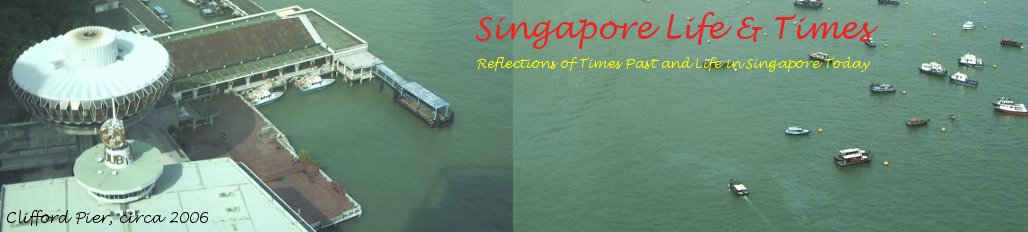
The Neptune Theatre Restaurant was closed last December. Now it is being demolished. A multi-storey building will probably take its place. In time, this new building will take away the breath-taking view from the building that these pictures were taken from.

Clifford Pier remains untouched. It is considered historical and will therefore be preserved. Thankfully, some people on this island do value our past, if only to milk money from it eventually as a tourist showpiece.

Don't blame my cynicism. A long time ago, many bemoaned the demolition of the iconic National Theatre. Some are still smarting from the demolition of the National Library, making the point recently that the tunnel that was the reason for it demise just isn't worth it. The building is gone and the tunnel is already in operation. In retrospect, many are (still) saying that exchanging a building where people applied their minds and hearts just couldn't compare to a hole in the hills where people applied their accelerators.

Hopefully this mass of concrete will yield something more useful.

Friday, March 23, 2007

Free to mooch

Yesterday, I switched on my Office Notebook at home to do, what else, some work. This involved my signing into my office's e-mail system, so internet access was required. No problem, I have had a wireless network running in my home for ages. But I was shocked to note that my wireless connection was hooking up automatically with one named 'linksys' instead of my wireless router, which of course, has a more meaningful name.

Curious, and alarmed, I called up the wireless networks list and sure enough, I was riding on an unsecured access point. In fact, there were more than 10 wireless access points listed, some of which were unsecured. I am a bit disturbed that wireless users still keep their access points totally unsecured even after the high profile court case of a 17 year-old moocher in Singapore, who was convicted of using his neighbour's unsecured wireless internet connection. Do these people with unsecured wireless APs expect to make use of the publicly-funded DPP's time to prosecute violaters?

There was an ensuing debate about whether, essentially, the law was an ass. Shouldn't the person with the wireless access point secure it in the first place, failing which his connection should be considered free for all? Indeed, I find it increasingly harder to justify the law that says riding on an unsecured wireless access point is a crime. Often, it is more a life-saver and a great convenience because it allows us to stay connected via e-mail and other wireless devices, albeit without paying a single cent. Tell, me, Mr Judge and Mr Public Prosecutor, when you are in a remote location with your Notebook and you find a 'free' wireless internet connection, would you refuse to use it? Really? Honestly?

I believe that it is up to the owner to secure his/her access point failing which that access point should be considered free to use. As the law says, ignorance is no excuse.

Sue me.

Saturday, March 17, 2007

Lip Service

Lip Service of the Month:
Housewives are worth billions
$10.2b to be exact, according to a University Don who made a considered calculation of the worth of housewives, or stay-at-home-mums, or whatever label you want to tag on them. Funny, I spend thousands a month supporting one. Where's the money?

Even government MPs spoke up for this silent group about how they have been left out of the budget goodies announced recently. Well, you and I know that if the government were to keep dishing out goodies to all and sundry, I, the taxpayer, end up paying more, right?

So I would please ask the well-meaning MPs and U Dons (sounds like Japanese noodles) to hold their horses lest they cause a stampede that will flatten us taxpayers. Of course, our PAP MPs aren't necessarily thinking about increasing the personal tax rate (never mind that it wasn't lowered a single hundredth of a percentage point), but probably milking the surpluses the government tends to run from its many creative taxes and surcharge schemes, from Cars to Roads to Death (aka Estate Duty).

Let's see if all this is idle talk. I, for one, think that it is just political lip service that has to be paid. Nothing will come of it.

Thursday, March 15, 2007

Need for a feed


A recent survey revealed that it is the relatively young among Singaporeans (20 - 35, I think) who are least conscious about littering. Well, my experience suggests that the younger ones are also either unaware about the reasons behind our 'fine' city's reputation, or they cannot be bothered. This picture of a young man eating away in our subway train oblivious to the 'no eating' sign just across from him, if he had bothered to lift up his head and read, is evidence of this.

This is not an isolated case. I have seen many young chaps and chapees like him eating away on buses and trains like it is nobody's business. What's more, nobody bothers to remind them, including myself. Why risk a scolding for helping the transport company keep their rules when they aren't too concern about how much they charge you for a ride, or how often they turn up to pick you up at their stops?

Yeah, great excuse.

Tuesday, March 13, 2007

Two's company

When I was in Primary school, I was taught that the maximum number of people that Singapore could accommodate was 2 million people. Today, I know that that number is wrong by 2.5 million, for the population of Singapore is 4.5m today

Now, we are told that that limit is set to increase to 6.5 million. Many Singaporeans are uneasy with that number. Singapore is already quite crowded. Look no further than the MRT stations and trains in operation during rush-hour on weekdays. Look at the gridlock on Orchard Road around the same time and you will see that the car problem contributed by too many people driving.

More people = more cars is obviously a truism in Singapore. "Are our planners out of their minds?" you ask. I speculate that they must have been to Shanghai recently. During rush hour, the subway trains in Shanghai are so packed that you just cannot move - and I thought Hong Kong was bad enough. I was placing a call to a friend the other day in Shanghai and I became anxious when she did not pick up the phone - twice. Later, she explain that she was on the crowded subway train when I called but she just could raise up her phone with her hand in the sea of people packed and surrounding her to talk to me. It was that crowded. And this hyper-crowding is a Mondays to Fridays rush-hour phenomenon.

Some officials in Singapore must have a warped sense of space and decided that sardine-packing people into the subway trains is 'world-class best practice' and optimum use of land. The train operators must have jumped for joy when they were consulted accordingly (well, we have had a consultative government since Goh Chok Tong). So the planners punched their Hewlett-Packard calculators (sorry Casio's are too cheap, though they should be accurate up to 6.5million, at least) and came up with 6.5m. What I am flabberghasted is that the government says that this number is for planning purposes only and does not represent the number of people that will dot the land one day. This is what is called official-speak, double-talk, hoodwinking, bluffing or just plain confusing. I cannot understand what they mean by what they said - and by a government Minister in the recent Parliament sitting to boot. We plan for 6.5m but will not have 6.5m? Hmmm, let me dig out my English language books to review that. I might have missed something in all my years of studying the English language.

But what we do know and have learnt over the last 40 years is that if the PAP government says so, they will do so. So if I had some spare cash, I'd buy up SMRT and SBS Transitlink stocks today. Their appreciation is a Singapore PAP government-back certainty. Hmmm...and while I am at it, let me look at some property investments too.

Wednesday, March 07, 2007

Holy cow! The ground is moving

Holy cow! The ground is moving. Well, not actually. Most people on ground level yesterday at around 12.15 pm or 1.50pm in Singapore would not have felt nor experienced the earthquake tremors that enveloped the island due to a 6.x earthquake on the Sumatran island. I know because I didn't feel the tremors when I was at the third level of one building and walking back to my office's building during the 11.50-12.10pm time window when tremors struck the island yesterday. I phoned home at about 1pm to check if the tremors were felt in my 7th floor apartment. It wasn't, though we learnt later on the news that Pasir Ris, which is near Sengkang, experienced the tremors. Apparently, some people in Potong Pasir felt the tremors at near ground level.

But when the tremors struck again at around 1.50-2pm (didn't read the exact time, except that I was preparing for a meeting at 2pm yesterday) I was at my desk on the seventh floor. I felt my chair moving back and forth on its own while I was working on my computer. It was surreal and yes, there was a sense of dizziness. I evacuated the building immediately, walking down all 7 floors. This wasn't that bad. Some people on other parts of the island reportedly walked down more than 30 floors, not daring to risk the lifts.

This is unusual, not that Singapore doesn't experience tremors that originate from afar, but that it is so widespread this time around. Well, as expected, it turned out to be from Indonesia where the epicentre was reportedly about 50 km from the city of Padang on the western coast of Sumatra. Unfortunately, 71 people reportedly lost their lives there.

Read more about the quake here:

Singapore shaken after quakes in Indonesia
Powerful Indonesian quake kills at least 71
BBC: Indonesian earthquake

Tuesday, March 06, 2007

Maid in Singapore

I was waiting for the train at Potong Pasir last Friday evening - my daily routine - to get home after a hard day's work. Usually, the train going up north will have standing room only, but yesterday, an empty train came from the north, stopped at Potong Pasir station and headed north again. I guess something must have happened along the rail that day - another rail suicide, perhaps?

Whatever happened, I got a comfortable seat and noticed a couple and their maid with a pram in tow, containing a toddler of about 2-3 years just across from where I sat. This is not an uncommon sight in Singapore nowadays, but it is a disturbing one. Assuming that that couple has only that one son (I didn't see another), we are looking at 3 adults looking after one toddler - an overkill by any measure, don't you think? Just because one can afford a maid doesn't mean that one needs to engage one. Is it so very hard to look after ONE toddler nowadays? If that is not the maid's primary responsibility, what is she doing out with the couple then? They weren't ladden with bags of shopping either. Shouldn't the maid be at home cleaning the house and cooking dinner, or perhaps looking after the aged parents of this couple, if there is any?

Our children are becoming mini-emperors, and by the same token, couples of these mini-emperors are the great pretenders - the budget version of emperors who have bought their statuses at $350 a month or thereabouts and like to parade around with them. Don't get me wrong. I am not saying that all couples with maids are pretenders. But there are instances when the need for a maid is manifestly questionable. On the other hand, the mini-emperors phenomenon is much like what happened in China when the one-child policy was forcefully pushed down the Chinese' throat. Only, in Singapore, it is a matter of not willing to bear more children than not being allowed to do so. Everywhere a toddler goes in Singapore today, there is an entourage of mummy, daddy and maiddy accompanying, ensuring the comfort, safety, needs and wants of that ONE toddler by three grown-ups. Children have never had it so good, in fact, too good. Teenagers nowadays do not know how to sweep the floor (okay, vacuum the floor) and put their soiled clothes out to be washed.

So schools have found it necessary and perhaps therapeutic to organise outdoor camps and activities for these teenagers, only to have teachers complain about how 'spoilt' and molly-coddled their charges are. For example, a group of 21 students (about 17-19 years old) were told to plan their menus and BBQ for an outdoor camp. And what was the plan they submitted? Simple, have the food and the BBQ catered for - entirely outsourced! No need to go to the market, no need to cook, no need to do anything except wait for the food to be delivered . All they have to do, besides paying for it, is simply to eat it. This is probably an indication of what normally happens in their homes.

So while our students get sparkling results because of the many hours of extra lessons put in after school hours with tuition for every subject they take in school and then some others, they do not know anything else except to 'outsource'. Some call this smart and keeping up with the times, I call this shortsighted and regrettable. This dependency culture is going to boomerang on Singapore society in years to come, with detrimental effects.

What to do with our young ones who are fast growing up? I shudder to think about the day they 'outsource' us, the aging parents. Some say this is already happening.

Saturday, March 03, 2007

Made in Singapore

When the issues of procreation comes up in Singapore, maids and work-life balance are often mentioned in the same breadth. Many see these two as prerequisites for bearing children, not love nor a desire to share with each other the joys of an offspring. Carrying on the family lineage must be the last thing on most young Singaporean couple's mind nowadays. It is common to see them getting a public-housing apartment and moving away from the parents. With the absence of parental nagging, the impetus to 'go multiply' for the sake of the family name will be absent.

Don't get me wrong. I am making no judgement either way about a couple setting up house without the parents, nor even about getting that public housing apartment on marriage. Most young couples do that. I was one of them in my time, and our parents do not stay with us although we have room. The story is a long but amicable one.

Often a couple thinks that if they are to bring anyone into the world, they must be ready to provide the best for that youngling. So many couples work and strive to climb that corporate ladder to this end, or so they pretend that that is why they are doing so. But they forget that biology is not on their side, at least not on the women's side. Many think that the women can still give birth way past thirty. Yes, you can, but many never factor in issues of post-natal problems after the first child, which may put a stop to the possibility of conceiving a second time, much less a third time. Furthermore, there are the issues of providing care for that first child that may wear out the couple, so much so that they will probably have second thoughts about a second child, which leads me on to the issue of maids and work-life balance.

Many women argue that the discrimination, real or imagined, that they face at work when they get pregnant (or hear about other women's experience) is a total put-off. The problem is real and often difficult to resolve. The government is willing to throw money at the problem, to make the financial loss more bearable for the employer. But lets be frank - pregnancy of a female staff is never a good thing for business. We are not talking about losing an employee's time, but also experience and expertise in her work. It is even more difficult to replace staff the higher up they are. If it were possible, what reason would the pregnant women keep her position, except the law and some dispute resolution parties? Really, we have dug ourselves into a hole by being so successful with our educational system and the largely equitable opportunities thereafter. I am not sure that aggressive economic growth is consistent with biological plenty.

Well, I have no solution to offer except that something has to give. That is the hard choice that we are faced with in Singapore today. We have seen that money, on its own, cannot solve this problem.

Now, about the maid...

Monday, February 26, 2007

Priorities in life

In a bid to sustain the standard and way of life that Singaporeans have become used to, very often, both husband and wife, mother and father, MUST hold down a job in ultra-competitive Singapore. I remember a time (my time) when the wife stays at home to raise the kids while the man brings home the bacon. But of course, that is a bygone era. With both male and female getting equal educational opportunities and career options in Singapore, it just doesn't make any sense for the wife to stay at home when she can be more productive, for home, country and vacations, holding down a job that provides more of the good material things in life, not to mention the spa holidays for relaxation and re-charging of the spirit and soul from time to time.

But the cost has been found to be in the declining birth rate among Singaporeans. We are already in crisis because apparently, we are not reproducing enough to replace ourselves. In time to come, we might just become extinct, to be replaced by migrants from other lands, just as our parents and grandparents themselves were migrants in Singapore in their time. So who are we building our homes for anyway? Does all this even make sense when we cannot reproduce enough of ourselves? I think we must come around to changing our expectations of what should be before this reversal will take place. Importing people will only go so far because in time to come, they will be just as unproductive as they assimilate and, inevitably, adopt the Singapore way of family and working life.

I argue that in Singapore, every couple should strive to work towards a single breadwinner family, the sooner the better. This means that Singaporeans must radically change their priorities. So instead of acquiring a car and a condo first, they must ensure that one of them earns enough to support the rest of the family - children and, preferably, grandparents included. Many would protest that this is impossible to do in Singapore, but really, with the re-arrangement of priorities, it can be done. I often marvelled that my father, with a salary not exceeding $500 a month, managed to raise 5 kids with the help of a very shrewed and thrifty wife. They knew where their priorities lay.

Some of you will not be convinced because you'd say, that was thirty years ago. Society has changed, and the standard of living has changed and all that. I can only say that I have done it. My wife doesn't work. She stopped working 4 years ago. I am the sole breadwinner, and by God's grace, we live in a condo. And I am just a salaryman, not even near one of the many millionaires that are sprouting up on the island these days. I just do not drive a car. That saves a lot of money, so I am told by people who do own a car. Well, I do have to live with the vagaries of public transport, including figuring out the pysche of Singapore taxi drivers. But its a trade-off that I have gotten used to. I can take my family on overseas vacations not once, but twice a year. And no, I do not try to supplement my income on 4-D and Toto. I don't make a cent from the stock market either because I am not good at it at all. If nothing, all my small and infrequent investments in equity have lost money.

So I am not convinced that, Singaporeans, when presented with a choice between family and work, work (the rice-bowl) must necessarily always come first. It is a matter of priorities. You can live relatively comfortably in Singapore without both husband and wife working. This is a myth that must be slain here and now.

What are your priorities?

Image source: http://www.northcoastchurch.com/

Sunday, February 25, 2007

Queue Logic

Getting a taxi in Singapore in certain locations at certain hours of the day on the island is a real bugbear. It is not uncommon for people to stand in line for over an hour before they can board one. So the LTA (Land Transport Authority) has come up with a 'brilliant' idea - put up signs at the taxi stands to inform would-be commuters the average waiting time for a cab. This will allow them to make an inform decision either to wait or to go somewhere else to wait. Apparently this has reduced the waiting times at 'notorious' taxi queues at Ngee Ann City, Paragon, etc. I wonder how long this heavenly state of affairs will last, though. (Well, not long, going by yesterday's Straits Times story about the waiting woes at Ngee Ann City).

One would have thought that the natural logic of clearing queues is to broadcast queue info to the taxis (instead of commuters) so that these drivers can head straight for the business instead of cruising aimlessly. Curiously, it doesn't work in Singapore. It isn't that our taxis are not equipped with the necessary receivers. In fact, almost every taxi in Singapore has an LCD-equipped, voice-enabled and satellite-based system that allows the taxis to take bookings. Strangely though, it isn't used to track places where there are most people waiting for a taxi.

You know why this is so? Because taking a taxi booking is more profitable than driving to a location to pick up passengers. Unlike Changi Airport and some selected remote corners of Singapore (e.g. Singapore Expo), cabbies are not re-imbursed for the trouble of getting to a particular location. Well, surely there must be cabs nearby that will take that little extra step to earn their keep? The problem, my friend, are those 'trigger happy', impatient and oh so superior people who cannot see themselves as queuers. Once they see more than 1 person in a queue, they would immediately whip up their cell phones to book for a taxi, 'spoiling the market' in the process. When cabbies detect that people are placing calls in the vicinity (yes, their equipment are THAT sophisticated), they'd naturally slow down, dive into a car park and wait for a booking. Its at least $3 extra for the dodging effort.

What can we do? This isn't a new problem. Its been there for a long long time. The only thing that solved this problem, for a while, was the economic recession of 2003 when everybody was careful about their last penny. Now in these times of plenty, they find it easier to throw a couple of bucks away. We are caught between a rock and a hard place indeed.