Showing posts with label Education. Show all posts
Showing posts with label Education. Show all posts
Wednesday, July 08, 2020
A great political speech, said from the heart #GE2020
A friend sent me this. Said it was one of the best political speeches he has heard. I watched and I cannot agree more.
Sunday, October 07, 2012
Cleaning after
 |
| Are you going to pick up the crud left by the previous diner? |
But now, there are increasing calls for diners to do the cleaning up themselves. Some have questioned whether this is fair as the price of the food probably already includes the cleaning services. Paid for or not, another group of people feel that it is gracious for each and every one of us to do the cleaning up. In principle, I agree. But in practice, we are not equipped to do so, much as we want to do so. And I am not trying to give any excuse. Just look at these 2 pictures which I snapped the other day. The previous diner just left the remains of his meal on the table expecting that someone else will clean it up. They didn't bother to pick them up to at least put them into the plate so that it can be cleared quickly, easily and cleanly. I thought it would have been more sensible if they had at least put the remains into the plate or bowl so that the next person can just clear the plate without having to handle the leftover food, if they don't clear the plates themselves, i.e. Restaurants such as McDonalds make it even more convenient for us to do this with the trays and bins. But even then, people just bring their bad habits from the foodcourts to the restaurants.
So long as these bad habits persist, it is going to be a tough sell to get people to clean up the tables.
 Clearly building return trays and pumping out messages isn't going to be enough. The problems really lies with ourselves. It is a habit of the mind. Do we ever really think of the person who will next occupy our seats? If they did, they wouldn't have left all that crap behind. Do they ever think that the mostly elderly cleaners can do with a little bit of help with less messy eating habits on our part, never mind that they are paid to do the cleaning? What if that elderly cleaner were your mother, or father?
So a first step towards cleaning after yourself and thus being more gracious is to get people to leave their tables in a more "cleanable" state. Fine if you want to leave something for the cleaners to clean so that they won't lose their jobs. It just doesn't take us a lot to have cleaner eating habits, does it? In fact, for such a highly educated people that Singaporeans generally are, it is surprising that they do not already practise these sensible, tidy, clean yet simple habits. Maybe what it take is to set a compulsory exam question in primary school around this. This will ensure that parents take the effort and time to teach their young so that they can 'score' in these types of questions. Hopefully, parents also learn in the process of teaching these gracious habits.
Sunday, September 05, 2010
Education Freedoms
The Singapore education system has been a subject of discussion lately. And no, I am not referring to the initiatives proposed by the Government through PM Lee's National Day Rally speech. Rather it has more to do with the cost of education. For some time now, parents have been engaging private tutors for their children. I don't know how many subjects, on average, that their children gets help from private tutors. If my experience is anything to go by, its probably between 2 and 5 subjects. The tuition industry, if one can call it that, is reportedly worth about $182 million per annum, not exactly small potatoes for a service that once used to be on the peripherally - for the really desperate, and for those whose parents have the aspirations for their children to gain admission to the top-top schools in Singapore.
Compared to private schools, such as those run by and for expatriates, the cost to Singapore citizens being schooled is really low. There are no school fees for the first 6 years of primary education - public education is free for citizens of Singapore. Students only have to pay a monthly supplementary fee of S$5.50, plus an additional S$5.50 discretionary fees. In the 4-5 years of Secondary School, fees are subsidized so much so that a student only pays S$5.00 a month - less than the price of a McDonald's meal, plus $8.00 supplementary fees and another S$8.00 discretionary fees. Yet when you add in the additional costs of private tuition, I daresay that education in Singapore is not all that free. In fact, the cost approaches half, if not more, of the monthly school fees that the expatriates among us pay for their children's education (about S$2,000 a month).
As so many who have written in to the newspapers recently on the issue of private tuition, this cost is not really discretionary. Yes, you can choose not to spend the money and see your otherwise brilliant child suffer the ignominy of being placed perennially in the bottom half of the class, or you can bite the bullet the spend the money in order to rescue your young child's morale and self-esteem. Is there any question what most parents must do? It is sad, no, it is a tragedy. Our schools are no longer the great leveler it used to be. Now those who have the means can ensure that their children move ahead, over and above others, educationally, at the expense of those less well-off. It is no longer a matter of whether one has the grey matter that matters. It is now loaded against those who cannot afford private tuition, or those who stubbornly DO NOT believe in private tuition for the reason that they believe the schools should have covered the bases. Education is free, isn't it? The schools provide equal education and instruction for every child, don't they? Private tuition is meant for the weaker students, right? Well, as many parents in Singapore now realize, this is a fallacy only the people in the Ministry of Education believe in.
How did we ever get to here, anyhow?
Compared to private schools, such as those run by and for expatriates, the cost to Singapore citizens being schooled is really low. There are no school fees for the first 6 years of primary education - public education is free for citizens of Singapore. Students only have to pay a monthly supplementary fee of S$5.50, plus an additional S$5.50 discretionary fees. In the 4-5 years of Secondary School, fees are subsidized so much so that a student only pays S$5.00 a month - less than the price of a McDonald's meal, plus $8.00 supplementary fees and another S$8.00 discretionary fees. Yet when you add in the additional costs of private tuition, I daresay that education in Singapore is not all that free. In fact, the cost approaches half, if not more, of the monthly school fees that the expatriates among us pay for their children's education (about S$2,000 a month).
As so many who have written in to the newspapers recently on the issue of private tuition, this cost is not really discretionary. Yes, you can choose not to spend the money and see your otherwise brilliant child suffer the ignominy of being placed perennially in the bottom half of the class, or you can bite the bullet the spend the money in order to rescue your young child's morale and self-esteem. Is there any question what most parents must do? It is sad, no, it is a tragedy. Our schools are no longer the great leveler it used to be. Now those who have the means can ensure that their children move ahead, over and above others, educationally, at the expense of those less well-off. It is no longer a matter of whether one has the grey matter that matters. It is now loaded against those who cannot afford private tuition, or those who stubbornly DO NOT believe in private tuition for the reason that they believe the schools should have covered the bases. Education is free, isn't it? The schools provide equal education and instruction for every child, don't they? Private tuition is meant for the weaker students, right? Well, as many parents in Singapore now realize, this is a fallacy only the people in the Ministry of Education believe in.
How did we ever get to here, anyhow?
Tuesday, May 11, 2010
A step behind
Anyone who visits China, even as a tourist, cannot deny that knowing the language is important. If nothing you would want to understand what the tour guide is talking about. You say, sure you can understand Chinese but not speak it. I know of some Chinese Singaporeans who cannot speak it, nor understand it. But of course, touring a country without knowledge of the local language is generally ok provided that you have a good guide.
But increasingly, many Singaporeans are heading to China for different purposes. To visit the country for business and for work. Some are there for educational purposes, to jiaoliu, for community service, etc., when a person stays at a stretch of 10 to 20 days. You would want to know how to speak the language, although writing is not quite necessary. But my experience last September was a real clincher for our attitude towards the language. I had met a teacher at a vocational institute in the course of the visit, a young man. He kept conversing in English with me. His English was already good, but every time I spoke in Mandarin Chinese, he would always reply in English. It isn't that this person doesn't know Chinese, just that he wanted very much to practise using English, to help him improve on the language. I, on the other hand, wanted to speak the local lingo in the land of its birth. But eventually, I settled on speaking in English with this chap, seeing how persistent he was in conversing with me in the language.
It is said that some China Chinese have become rich and they are traveling the world as first class travelers (stay in first class hotels, first class shopping, etc.), but many of them are becoming conversant in the international language of trade and commerce - English. I thought, if we don't work hard at their language (which for the Chinese among us, is OUR mother tongue), one day, they will dominate us, even if were are Singaporean Chinese.
But increasingly, many Singaporeans are heading to China for different purposes. To visit the country for business and for work. Some are there for educational purposes, to jiaoliu, for community service, etc., when a person stays at a stretch of 10 to 20 days. You would want to know how to speak the language, although writing is not quite necessary. But my experience last September was a real clincher for our attitude towards the language. I had met a teacher at a vocational institute in the course of the visit, a young man. He kept conversing in English with me. His English was already good, but every time I spoke in Mandarin Chinese, he would always reply in English. It isn't that this person doesn't know Chinese, just that he wanted very much to practise using English, to help him improve on the language. I, on the other hand, wanted to speak the local lingo in the land of its birth. But eventually, I settled on speaking in English with this chap, seeing how persistent he was in conversing with me in the language.
It is said that some China Chinese have become rich and they are traveling the world as first class travelers (stay in first class hotels, first class shopping, etc.), but many of them are becoming conversant in the international language of trade and commerce - English. I thought, if we don't work hard at their language (which for the Chinese among us, is OUR mother tongue), one day, they will dominate us, even if were are Singaporean Chinese.
Thursday, May 07, 2009
Silvery tongue
To its credit, the Ministry of Education (MOE) has come out to state, officially and unequivocally, that the instructor guide used in the Comprehensive Sexuality Education (CSE) programme run by AWARE are "explicit and inappropriate, and convey messages which could promote homosexuality or suggest approval of pre-marital sex." (See Today, 7 May 2009, page 1 and Voices section, page 30; Business Times, 7 May 2009, page 3 - "MOE suspends AWARE 's sex education programme")
This vindicates the former AWARE committee's stance that AWARE has lost its direction. Indeed, it appears that AWARE's agenda has been hijacked by liberal elements, either from within or outside, that is pushing their views and preferences regardless of what the rest of Singapore society believes in or prefers. This insidious approach is worse than one where a particular religion is identified and accused of pushing its religious agenda. At least we know where they are coming from even if we may not agree entirely with them. By painting itself as non-religious and non-judgmental, the homosexual 'religious' faction has hoodwinked some, nay, many, naive women (and some men too) in AWARE into adopting, if not applauding, such liberal ideas and perverted practices (e.g. "Anal sex can be healthy, homosexuality is perfectly normal...").
Yes, more than a thousand women voted for the old AWARE guard, but I wonder among these group of people, how many are AWARE of AWARE's practices, particularly with respect to the CSE programme. I, for one,just got to know about it only in the last few weeks. If they are, do they approve? If they approve, will they let their children be schooled in this homosexual 'religion'? Is AWARE now a hotbed of homosexuals and homosexual sympathisers? If AWARE's CSE programme is neutral in its message about sexuality and choice, does the CSE give equal voice and emphasis to sexual abstinence as a choice, as Ms Charlotte Wong, former VP of the ousted AWARE committee has rightly questioned? And even if the CSE seeks to present a balanced view, as the old guard has always claimed, what has it put in place that will ensure that its trainers do not push their own preferences and biases in the classroom?
Josie Lau and her supporters may have lost within the confines of the Suntec City Convention Centre room by the 'ballot box', but it would appear that outside it, there is a significant number of people who are questioning the very practices that moved Ms Lau and her band to attempt to reform AWARE. Today reports that there are 7,000 signatures, so far, from people who have expressed concerns about AWARE's CSE. So before the old AWARE celebrate its 'victory' last Saturday (2 May 2009) for much longer, it must take stock of itself. Its President, Ms Dana Lam said that AWARE "will be open to seeing what has to be done" in response to the MOE ban, but in the same breadth, she said that AWARE will "stand by the programme. After all, we've been running it for almost 2 years."
I am worried. Can we ever trust what AWARE says now? Where along the way has it lost its integrity?
A critique of the secret CSE Manual: http://www.vtaide.com/blessing/AWARE-cse.htm - Thank you, Mr Alan S.L. Wong for the link.
This vindicates the former AWARE committee's stance that AWARE has lost its direction. Indeed, it appears that AWARE's agenda has been hijacked by liberal elements, either from within or outside, that is pushing their views and preferences regardless of what the rest of Singapore society believes in or prefers. This insidious approach is worse than one where a particular religion is identified and accused of pushing its religious agenda. At least we know where they are coming from even if we may not agree entirely with them. By painting itself as non-religious and non-judgmental, the homosexual 'religious' faction has hoodwinked some, nay, many, naive women (and some men too) in AWARE into adopting, if not applauding, such liberal ideas and perverted practices (e.g. "Anal sex can be healthy, homosexuality is perfectly normal...").
Yes, more than a thousand women voted for the old AWARE guard, but I wonder among these group of people, how many are AWARE of AWARE's practices, particularly with respect to the CSE programme. I, for one,just got to know about it only in the last few weeks. If they are, do they approve? If they approve, will they let their children be schooled in this homosexual 'religion'? Is AWARE now a hotbed of homosexuals and homosexual sympathisers? If AWARE's CSE programme is neutral in its message about sexuality and choice, does the CSE give equal voice and emphasis to sexual abstinence as a choice, as Ms Charlotte Wong, former VP of the ousted AWARE committee has rightly questioned? And even if the CSE seeks to present a balanced view, as the old guard has always claimed, what has it put in place that will ensure that its trainers do not push their own preferences and biases in the classroom?
Josie Lau and her supporters may have lost within the confines of the Suntec City Convention Centre room by the 'ballot box', but it would appear that outside it, there is a significant number of people who are questioning the very practices that moved Ms Lau and her band to attempt to reform AWARE. Today reports that there are 7,000 signatures, so far, from people who have expressed concerns about AWARE's CSE. So before the old AWARE celebrate its 'victory' last Saturday (2 May 2009) for much longer, it must take stock of itself. Its President, Ms Dana Lam said that AWARE "will be open to seeing what has to be done" in response to the MOE ban, but in the same breadth, she said that AWARE will "stand by the programme. After all, we've been running it for almost 2 years."
I am worried. Can we ever trust what AWARE says now? Where along the way has it lost its integrity?
A critique of the secret CSE Manual: http://www.vtaide.com/blessing/AWARE-cse.htm - Thank you, Mr Alan S.L. Wong for the link.
Sunday, May 03, 2009
RIP
The die has been recast, and the new has become the old and the old the new. AWARE members, many of whom just joined, voted collectively that they want the old AWARE back. The former new have bowed to the will of the majority who voted. Hopefully, we will see the end of this saga which has gripped the nation, young and old, male and female. It was perhaps a good distraction from the constant flow of bad news about the economy. Perhaps it is also timely because we now have to face a potentially deadly enemy - the Influenza A (H1N1) virus, which Singapore is trying its hardest to deny entry to our shores.
Unfortunately, there are hints of the continuing feud amid the threat of a lawsuite, as if the threat against people's lives earlier is not enough. I applaud the new old AWARE committee members, who were brave enough to take up a cause they believed in. Nobody can take that away from them. One may disagree vehemently with their way of going about the whole thing, but through it all, I think they succeeded in drawing much attention to the issue of homosexuality education in Singapore schools. The MOE is looking into this. They may find nothing wrong with AWARE's programme (why would they want to be found with pies on their faces?), but these programmes will face greater scrutiny now from the public, not only from Christians, but from the conservatives among us. And these include Hindus, Muslims, Buddhists and even the religiously non-committed, especially those with school-going kids. No one can ever be neutral on this matter.
Unfortunately, there are hints of the continuing feud amid the threat of a lawsuite, as if the threat against people's lives earlier is not enough. I applaud the new old AWARE committee members, who were brave enough to take up a cause they believed in. Nobody can take that away from them. One may disagree vehemently with their way of going about the whole thing, but through it all, I think they succeeded in drawing much attention to the issue of homosexuality education in Singapore schools. The MOE is looking into this. They may find nothing wrong with AWARE's programme (why would they want to be found with pies on their faces?), but these programmes will face greater scrutiny now from the public, not only from Christians, but from the conservatives among us. And these include Hindus, Muslims, Buddhists and even the religiously non-committed, especially those with school-going kids. No one can ever be neutral on this matter.
Thursday, March 26, 2009
Whiter than white
Is the Singapore school system barbaric? Does it not measure up to the Western liberal standards of enlightened education? Will students in Singapore schools suffer irreparable emotional damage? Should you pull your sons and daughters out of this barbaric regime that is the Sinagpore school?
Well, if you think about it, there is a lot of bad going on in the Singapore school system. Students not only have scheduled classes, they also have unscheduled classes with private tutors whose job it is to drill students to do well in school. Free time to enjoy your childhood/youth? Banish the thought. Slack a tinsey-whinsey bit and your child will fall to the back of the class, no, the back of the school, say position 459 out of 460. Students face so much pressure to do well that we are not certain if they will suffer permanent head damage (PhD) in addition to permanent social and emotional handicap in years to come.
What's this I hear? Somebody got three of the best on his behind in a Singapore school, and sanctioned by his parents, no less? Surely nothing can top this. To think that foreigners, Indonesian, Mainland Chinese, Burmese, Vietnamese, Malaysian and the Thais, send their children to be schooled here. What must these foreigner parents be thinking of? Are they sadists to put their children in harms' way, or do they just want someone else to do the spanking for them? Well, you can't blame them. Spanking is a very common punishment in this barbaric part of the world. You wonder why people from liberal western countries come in droves though. Are they also sadists? To learn from the natives, perhaps? But of course, they put their children into schools with superior educational systems and enlightened philosophies, never mind that they cost a bomb. Their training will certainly help them in future to create complex financial products that nobody understands so that, whether they mess up or not, they have to be paid obscene bonuses. What better profession is there in the Universe?
The natives? They can have their 3rd class schools, such as Raffles Institution. They just will not enrol their children in them. Their children are just superior beings, you know, not like the Ah Mads and Ah Sengs and Ah Lians you commonly find in these 3rd class schools.
This incident should be reported to President Obama so that he can reprimand Singapore, just like what a father would, but without the cane, mind you, just like what President Clinton did when an American got 3 of the best here, courtesy of the Singapore Courts, which of course, is barbaric.
Yeah, and those people who have gone overseas and got their brains washed by liberal detergent, if you cannot bear with the barbarism here in the tiny little red dot of Singapore, go back to where you returned from. I hear that they have whiter than white streets there. So white that people dare not venture into them when night falls.
Well, if you think about it, there is a lot of bad going on in the Singapore school system. Students not only have scheduled classes, they also have unscheduled classes with private tutors whose job it is to drill students to do well in school. Free time to enjoy your childhood/youth? Banish the thought. Slack a tinsey-whinsey bit and your child will fall to the back of the class, no, the back of the school, say position 459 out of 460. Students face so much pressure to do well that we are not certain if they will suffer permanent head damage (PhD) in addition to permanent social and emotional handicap in years to come.
What's this I hear? Somebody got three of the best on his behind in a Singapore school, and sanctioned by his parents, no less? Surely nothing can top this. To think that foreigners, Indonesian, Mainland Chinese, Burmese, Vietnamese, Malaysian and the Thais, send their children to be schooled here. What must these foreigner parents be thinking of? Are they sadists to put their children in harms' way, or do they just want someone else to do the spanking for them? Well, you can't blame them. Spanking is a very common punishment in this barbaric part of the world. You wonder why people from liberal western countries come in droves though. Are they also sadists? To learn from the natives, perhaps? But of course, they put their children into schools with superior educational systems and enlightened philosophies, never mind that they cost a bomb. Their training will certainly help them in future to create complex financial products that nobody understands so that, whether they mess up or not, they have to be paid obscene bonuses. What better profession is there in the Universe?
The natives? They can have their 3rd class schools, such as Raffles Institution. They just will not enrol their children in them. Their children are just superior beings, you know, not like the Ah Mads and Ah Sengs and Ah Lians you commonly find in these 3rd class schools.
This incident should be reported to President Obama so that he can reprimand Singapore, just like what a father would, but without the cane, mind you, just like what President Clinton did when an American got 3 of the best here, courtesy of the Singapore Courts, which of course, is barbaric.
Yeah, and those people who have gone overseas and got their brains washed by liberal detergent, if you cannot bear with the barbarism here in the tiny little red dot of Singapore, go back to where you returned from. I hear that they have whiter than white streets there. So white that people dare not venture into them when night falls.
Sunday, February 01, 2009
Learning and training
Someone asked me, "What's the difference between a test and an exam?"
I would have brushed off the question, thinking that he just wanted to split hairs, except that this question has gained a certain significance with the announcement by the government of the intention of scrapping exams for Primary 1 and 2 students and replacing them with tests to be held throughout the year.
Ever since this announcement, many Singaporeans have weighed in on the issues. Many feel that the absence of exams at P1 and 2 will disadvantage students when they eventually take exams in P3. There's this thing about practice and pain that almost all Singapore parents of school going children are all too familiar with. Right from Primary 1, if not earlier, parents engage private tutors to grill their children on how to work out problems and answer exam questions. If the private tutor did not have an inventory of practice questions for their children, his/her competence could be called into question. One wonders then if our more 'successful' primary school students are exam-smart or just simply smart? Of course, one can be both but a lot of cynicism has been expressed over exam-only-smart students.
So perhaps it is the right thing to do, abolish exams for P1 and 2 students and get them to really learn and not merely be trained, like you would a dog. But doubt lingers, and I am not convinced that you can brush aside such doubts. The current exam-heavy regime of education in Singapore will still be there - the PSLE, the GCE 'O' levels.... As many parents point out, from P3 onwards, exams will determine the options, directions and schools that their child can take and go to. And if you don't train them early, especially when they are young, their ability to cope later becomes questionable. Of course, the really smart ones will adapt quickly, but those needing coaching will now, ironically, get more extra-curricular coaching in anticipation and preparation for the P3 exams and beyond. After all, it is a conventional wisdom in government to take the long-term view. And this has filtered down to the governed(?) Perhaps schools will also offer such coaching because they will also be ranked. No principal wants his/her Primary School to be ranked last. It isn't good for the school's image and certainly damaging to morale and prospective promotions of teachers and principals in the dog-eat-dog world of education in Singapore.
So what is the difference between tests and exams? I would venture that, as far as anxious parents are concerned, the difference is like night from day. Somehow, exams are viewed as a more serious form of assessment and thus a true validation of the competence of their children's performance compared to tests, even if tests are held more often throughout the year. If the latest government initiative is carried through (and there is little reason for it not to), we might see tests evolving into mini-exams. This will mean an increase in the anxiety for parents, students, teachers and private tutors throughout the year.
Pity the educators.
See also:
Primary education in Singapore
Review of Primary education in Singapore
Image: morgueFile.com. Author:gracey

I would have brushed off the question, thinking that he just wanted to split hairs, except that this question has gained a certain significance with the announcement by the government of the intention of scrapping exams for Primary 1 and 2 students and replacing them with tests to be held throughout the year.
Ever since this announcement, many Singaporeans have weighed in on the issues. Many feel that the absence of exams at P1 and 2 will disadvantage students when they eventually take exams in P3. There's this thing about practice and pain that almost all Singapore parents of school going children are all too familiar with. Right from Primary 1, if not earlier, parents engage private tutors to grill their children on how to work out problems and answer exam questions. If the private tutor did not have an inventory of practice questions for their children, his/her competence could be called into question. One wonders then if our more 'successful' primary school students are exam-smart or just simply smart? Of course, one can be both but a lot of cynicism has been expressed over exam-only-smart students.
So perhaps it is the right thing to do, abolish exams for P1 and 2 students and get them to really learn and not merely be trained, like you would a dog. But doubt lingers, and I am not convinced that you can brush aside such doubts. The current exam-heavy regime of education in Singapore will still be there - the PSLE, the GCE 'O' levels.... As many parents point out, from P3 onwards, exams will determine the options, directions and schools that their child can take and go to. And if you don't train them early, especially when they are young, their ability to cope later becomes questionable. Of course, the really smart ones will adapt quickly, but those needing coaching will now, ironically, get more extra-curricular coaching in anticipation and preparation for the P3 exams and beyond. After all, it is a conventional wisdom in government to take the long-term view. And this has filtered down to the governed(?) Perhaps schools will also offer such coaching because they will also be ranked. No principal wants his/her Primary School to be ranked last. It isn't good for the school's image and certainly damaging to morale and prospective promotions of teachers and principals in the dog-eat-dog world of education in Singapore.
So what is the difference between tests and exams? I would venture that, as far as anxious parents are concerned, the difference is like night from day. Somehow, exams are viewed as a more serious form of assessment and thus a true validation of the competence of their children's performance compared to tests, even if tests are held more often throughout the year. If the latest government initiative is carried through (and there is little reason for it not to), we might see tests evolving into mini-exams. This will mean an increase in the anxiety for parents, students, teachers and private tutors throughout the year.
Pity the educators.
See also:
Primary education in Singapore
Review of Primary education in Singapore
Image: morgueFile.com. Author:gracey
Monday, December 15, 2008
Superkids
 Last Friday night, I met up with some ex-colleagues whom I have not seen in a while. We were part of a small outfit then, all of us young and unmarried. So I suppose, without the husbands and wives and children, we got to strike up close bonds as only young people do.
 Now we are much older. The oldest child we have among us is already in Junior College - all of 17 years old. So it was natural that part of the conversation over dinner turned to children and their education. Pre-school education was raised - words like Kumon and what-nots came up in the free-flowing conversation. Apparently, many of my ex-colleagues have sent their toddlers to these specialist schools to, I suppose, gain a leg-up in life. All this while I kept silent, because I never ever believed in these schools. I sent my son to a PAP kindergarten for two years, and that was it. Tried to get him interested in Piano, but he wanted out after a few lessons. So that was it too, until he was enrolled into a neighbourhood school just 7-10 minutes walk away from where I lived. He passed his PSLE with straight As (although A+ would have been more impressive), got into another neighbourhood Secondary School, now biding time till his 'O' levels.
Such is the life of every Singapore boy and girl. We have to pass through 2 major exams in our young lives, exams which many parents treat as a matter of life and death. So I could empathise with a parent who wrote in to Today's (15 December 2008) forum page lamenting the lengths to which Singapore parents would subject their children to regimentation memorisation, regurgitation, creativitisation, etc. from as early as 2 years old. I often wonder if there is anything wrong with us parents. We bring a child into the world, and just as soon as they are ready to walk, we rob them of their childhood by subjecting them to an endless regimen of training in the hope that they will turn into an Einstein or, at least, some'thing' they could brag in parties and gatherings.
I often also wonder whether, somewhere along the line, education in Singapore has taken a wrong turning, for the worse. I do not know, but 20-30 years hence, when our children themselves becomes parents, they would reverse these practices because they know it didn't so much benefit them as it did their parents. I would be disappointed if this state of affair is perpetuated by them and those that come after them. Then we would know that the turning has been too sharp.
Thursday, October 09, 2008
Messing up
 It just won't work. I wish it would and look forward to the day that it becomes a part of our lives. But it wouldn't work in today's Singapore. It could have worked perhaps 20, 30 years ago when social behaviour was highly prescribed, tightly controlled and vigourously enforced. Not today. We are more enlightened, grown up and can make our own decision and choices. Ironically, that also means that we can choose not to return or clear our food utensils and trays after a meal in a cooked food centre, variously referred to also as a Hawker Centre, Eating House and Foodcourt. Fastfood Restaurants such as McDonalds, KFC and Long John Silvers are no exceptions.
But this is exactly what Straits Times editor, Mr Han Fook Kwang, wishes to see - a more gracious Singapore where people clean up after themselves - not just in the loo, though that is something that needs working at - but at the tables in these food centres. Anyone who arrives at these eating establishments hopes to find an empty table which they can plonk down on and start ordering their meals immediately. Nobody wants to have to wait for the tables to be cleared of the debris left over from the last occupier of the table, and less so if the last occupier was a messy diner. Nobody wants to clear the mess themselve either. They simply choose a cleaner table or worse, walk away to another more inviting eating place. Right now, all of these eating places engage cleaners who walk around the place the whole day cleaning up after every diner, and I mean every diner. That is because even if one doesn't mind doing the cleanup, we'd leave it to the cleaners who can do a better job, really.
You see, it has become established practice that tables are to be cleared by paid cleaners, as much as our household trash is to be carted away by the trashman in their trash-trucks. The reasoning is that the cost of the meal already includes this service, so it would be nothing short of moronic to do what you have already paid someone else to do. But removing these cleaners will not do either because the trash on tables will begin piling up and, given the cost of food nowadays, no diner will volunteer their cleaning services. That's why paid cleaners came into the picture in the first place. It has become a circular thing, no?
Some have been inspired to suggest that you should make the students in Primary, Secondary and Tertiary institutions do this first - i.e. clear the tables themselves after a meal. The logic is that once these students have imbibed the habit, they will naturally carry over this habit outside of school. I am not that optimistic about this approach for the reasons already stated earlier. Further, these new adults do not want to appear kiddy to others by bucking the adult practice of returning trays in public eating places. In fact, not returning trays can be seen to be an 'adult' thing. Its just like saying the National Pledge and singing Majulah Singapura. You don't do that everyday after leaving school. Some even do not want to be seen doing that. So it wouldn't work.
Let's have a compromise. The one thing that irritates me more than anything in an eating place is when diners leave behind a table that looks as if a rat has rummaged through the leftover food. It looks like a hell of a mess with fish bones, curry, used tissue paper, etc. lying all over the table. I don't understand how and why people eat like that. Granted you can't ask them to swallow the bones and lick the curry off the tables and pocket their soiled tissue paper for disposal elsewhere, but they could have started by practising considerate clean eating habits. Get an empty bowl/plate to desposit the leftovers, or if non is available, use a tissue paper or two which is always available, if nothing, to 'chop' seats, from your own pocket. If you spill curry on the table, wipe it off with the paper and deposit it in the empty bowl, plate or cup which you have eaten or drank from.
This way, it makes it easy for yourself or anyone who comes after, to clear the table without the help of a professional cleaner. Yes, the cleaner will lose his job, but if this is what we want as a gracious society, then too bad. I did mention that is is a compromise solution, right?
Image source: morgueFile.com. Author: Anita Patterson Peppers
Monday, August 18, 2008
Baby load
 One of the greatest burdens of having a baby in Singapore is not about money. Rather, the problem is how to ensure that that baby grows up to become a government scholar or at least one who isn't ranked in the last 10 in class. This is the real challenge that parents are forced to face in Singapore society - and it isn't pretty. It doesn't matter if a child is scholarship material or not, parents naturally want their child to do well, no, extremely well, in school. To that end, it is common knowledge that almost every school going kid in Singapore has a private tutor on top of their school teachers, to pile them with additional school work and supplementary exercises. Kiasu parents want to ensure that their child does not fall too far behind the rest of the students in the school, whose parents would most likely also have have engaged a private tutor for the same reasons.
And the problem is a real one. Let's get one thing straight. Not everyone can be first in class. No every can get a scholarship. In fact, those who do so are the exception. The rest of us are the ordinary boys and girls who get by. But the competition to be that exceptional student is such that reality is often suspended over fantasy. And this fantasy is often an expensive affair. One has to shell out more than a $100 per subject per student per month. Multiply that with 3 or more subjects and you're really out of pocket by a couple of hundred $$. Multiply that with 3 or 4 kids and you begin to understand the problem with money. But money, really, is not the only problem. The problem is the mental anguish and superhuman effort parents need to put in to ensure that their child do do well. And time really is not on our side, not when we need to work those hours to earn enough to pay the tutors and the additional enhancement lessons during weekends. I know of a parent who has a somewhat wayward (but academically capable) son. In spite of all his effort and that of his wife, he just couldn't get his son to 'do the right thing' in school. In his word, he was '....getting so tired of supervising and managing his son' that he was about to just give up. This mental challenge and anguish, if multiplied 3 times would kill any parent. Which explains why a couple doesn't desire more than 2 kids, no matter how much the financial incentives dangled in front of them by the government. You either kill your child's interest and young lives with after-school tuition after tuition, or your own sanity trying to manage the child, or, heaven forbid, both.
That is why the government's incentive programmes, which have largely revolved around financial help, haven't really worked. The latest reported replacement birth rate in Singapore is 1.2, hardly enough to replace ourselves in the long run. So long as this pressure cooker environment persists in Singapore, the government can forget about increasing the birth rate. It may as well do what it has silently been doing for some time now in increasing the population - import foreigners and make than locals - eventually. But then, the children of these foreigners will eventually still need to join the junior rat race, so that will then lead us back to square one - rationalizing whether having more than 2 kids in this pressure cooker environment is desirable at all.
Image source: morgueFile.com. Author: manuere
Saturday, May 03, 2008
Wrong righted

But the problem is, acquitting someone on the basis of reasonable doubt does not automatically result in the conviction of the accusers of a crime. Right now, the kids who perpetrated the falsehood are free. I doubt that Mr William Ding, the aggrieved party, would want to pursue the matter further, not after going through an ordeal lasting no less than 3 years. Those 3 years saw his teaching career come to a halt and his reputation sullied. The public's natural sympathies, including mine, would tend to rest on the oft-perceived innocence of youth. Fortunately for him, there are family and friends who believe in and know enough about him to keep faith. And I think that the Ministry of Education will do the right thing in expunging all records of the alleged wrong doing from Mr Ding's files notwithstanding the fact that he has moved on to a new career.
Whether Mr Ding wishes to pursue the matter or not, those kids who hatched the plot should face some punishment or other in order to serve as a deterrent to them and others from ever bearing false testimony against an innocent person, one as grievous as an accusation of sexual misconduct.
Image source: www.morgueFile.com. Author: Jim
Saturday, April 12, 2008
Sweat out the invention
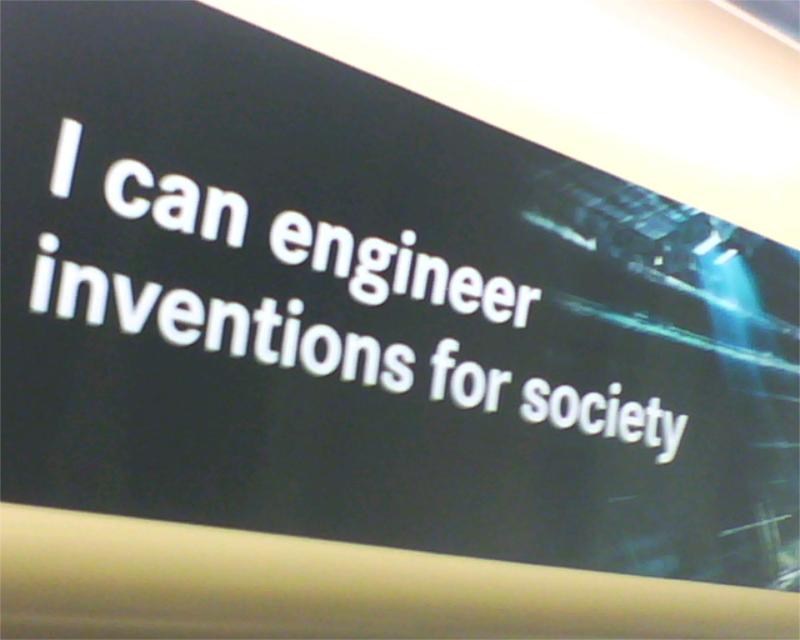
I didn't know that inventions could be engineered. If it could, then Singapore should have thousands of inventions to its name, given that it produced that many engineers in the 80s and 90s, most of whom have become paper-pushing administrators today. Singapore does not hold that accolade. I believe the US does. Ironically, it is adopting Singapore-produced textbooks for some of its schools today. Singapore is now scrambling to produce R&D people, people who could come up with inventions or innovate new products through the greater emphasis and money going into its push for R&D. In typical Singapore fashion, we are going to engineer the inventions, as this signboard in an MRT train car would suggest.
But of course, give Singapore more credit. It understands the process (if it exists) and it is doing its damnest to create the environment, if not the people, to go into R&D in larger numbers today. But as with all things that comes from the top in Singapore, it is a targeted push. With the amount of money that is being poured into this push, I am sure inspiration will come. However, as Edison would remind us, it takes a lot of sweat too.
Thursday, July 26, 2007
'A' levels not on the level
Sir Peter Williams has come out to say that the GCE 'A' level examinations - a British institutional exams adopted by Singapore for decades - have been getting easier over the last few years. No wonder Singapore keeps churning out so many students with straight As. Compared to my time, one would have thought that our children are getting smarter. In fact, it's not so much our student getting smarter but the exams getting 'more stupid'. Sigh, and I thought we have made great advances in our education system.
I'd imagine now that the egos of students (and their parents) who have gotten fantastic 'A' level results to be deflated somewhat by this news from the horse's mouth. It also assuages my ego to know that my 'A' level results were not all that poor compared to our kids' today.
Friday, June 08, 2007
Educating educators
Singapore's effort to become an educational hub took another big knock with the troubles at the Froebel Academy - a privately run school that provides mainly Early Childhood programmes as well as its flagship Chinese Diploma in Pre-School Education.
Following so closely on the heels of UNSW (Asia)'s closure, it is no wonder that students at this academy are alarmed at any sign of irregularity at the school, such as unpaid salaries, delayed certificates, etc. The breaking point came when students found the school closed for unknown reasons, although the operators seem very much to be alive and kicking, though invisible for now. It is probably better that they do not make public appearances lest they get pelted with eggs and cause a riot in the process.
Privates businesses, even in education, can fail or close or both, just like in any commercial enterprise. But if the government is serious about making Singapore an education hub by riding on the good track record of its education system that has been established for more than 30 years, then it must exert greater supervision over any and all private educational institutions or academies sprouting up all over the island nowadays. At this point in time, the government is taking a hands-off approach, preferring to let bodies such as CASE validate the trustworthiness of these 'schools'. Beyond registering these schools, the MOE does not seem to be monitoring them as closely as it would seem necessary.
Look, Singapore's reputation for the quality of its education sector is well-deserved. But I would hate to see a few high profile failures bring down this reputation overnight. The powers that be needs to do something, and do it fast, though not in the manner in which UNSW was coaxed into setting up a full-service campus on the Island just to be closed in one semester. This must be a world record of sorts, though one that Singapore certainly does not want to be known for in the long run.
Meanwhile, the Froebel Academy saga continues...
Image source: http://images.stockxpert.com/
Monday, May 28, 2007
Education capitulation
How can a major University, and a prestigious one at that, close its campus only three months into its operations in Singapore? If this happened in a banana republic, we can understand it. But in Singapore, where anything and (almost) everything is done with due diligence and consideration, this is incomprehensible. Don't get me wrong. I am not implying that the powers that be, whether the EDB, MOE or any other government body involved in the setting up of the University of New South Wales in Singapore (UNSW-Asia), was negligent. But I did find Tharman Shanmugaratnam's, the Education Minister, comments a bit grating when he said that the problem was UNSW's - forgetting that Singapore actively courted the Institution to Singapore as early as 2004.
Yes, UNSW also didn't do its sums properly before recruiting faculty and students. It appears now that their plan B, just in case the numbers were not achieved, was to close the school. You wouldn't expect this from a prestigious University. First for getting their basic Math wrong, and second, for its ruthlessness. How else do you described their 'cut-and-run' approach? This is no different from what a 'fly-by-night' company usually does - run at the first sight of trouble! The most adversely affected must be the faculty, who may have resigned stable positions to take on their teaching/research positions at the University. Unlike the students, I am not aware that anything beyond a severance package (and that isn't assured) has been offered. This really calls for some mudslinging. But of course, academics will not stoop so low(?).
To be fair, students do have options, and the $10,000/$22,000 grant does help. But the damage is done. Who now will enrol into a foreign University on this island, even if it is set up with the EDB's blessings? While the reputation of UNSW has taken a bad knock, that of the EDB's mantra of authority and certainty in attracting local and foreign students to buy into any foreign educational institutions it helps to set up has suffered irreparable harm.
Image source: http://images.stockxpert.com/
Subscribe to:
Posts
(
Atom
)