Perform Group who? Well, this name may be welcome music to football hungry people in Singapore. Just when Singaporeans face the increasingly likelihood of not being able to watch 'live' telecast of all 64 matches of the Football World Cup in June 2010, along comes this company that says that it can stream all these matches, but via the Internet. It further boasts that the streaming will be of good quality as it has had experience streaming the Australian Open Tennis competitions and others sports competitions. Well, it wouldn't be free. It is likely going to be pay-per-view deal, with prices like S$11 / S$12 dollars per match being quoted based on its past broadcasts.
If this happens, it'll be great for people who use their computers often, and also for those who can hook up their computers to their LCD TV sets. But the quality will not be as good though, depending on your Internet connection bandwidth, and your PC. Even with the Next Generation Broadband (NGB), which is not available to most Singapore households yet, it cannot match Starhub's dedicated infrastructure. So yes, the option will be there, but the experience may not. Internet speeds are only as fast as the connections across the internet network, which may pass through shared undersea and overland cables and various machines hosting the IPs along the same network.No one can determine the exact path that an internet connection passes through, even if you have a million dollars.
The question that must be asked is; why is Fifa willing to do a deal with this London-based company and allow the Worldcup matches to be accessible to Singapore when they will not back down on the reported S$40m they are demanding from Singtel/Starhub? It is not as if Performance Group's technology is out of this world, cutting edge or anything. Why let a foreign company profit from this business and deprive Singtel/Starhub? If all this is true, then Fifa's discriminatory pricing and predatory practices are not only reprehensible, they are puzzling also. Just because Singtel paid an arm and a leg for the rights to the BPL matches doesn't mean that it can levy the same or more for the Worldcup matches. Whether Singtel makes a profit or loss from this BPL deal isn't even certain and anyway, it is their business, not Fifa's.
What is the relationship between Performance Group and Football Media Services, which is the exclusive sales representative for Fifa in Asia? If Performance Group is given the business, then Football Media becomes a real joke. It levies astronomical sums on Asian businesses but gives the same to a London business entity (read: non-Asian business) for a song? This whole Fifa farce has gone on long enough. I pity that Singtel, Starhub and Mediacorp have been hoodwinked into dancing the ultra-expensive Fifa tango. It is sad that Fifa can act in such unprincipled and monopolistic manner, if my analysis of this whole Performance-Fifa shenanigan is correct.
Singtel/Starhub may have been taken for an expensive ride, but lets not have the same happen to all football loving Singaporeans.
Saturday, January 30, 2010
Monday, January 11, 2010
Religious fear
Someone reputable made the observation that a Google search on the word "Christianity" will throw up results such as "Is Christianity Absurd?" and "Christianity is Stupid" on the first page of the search results. On the other hand, when 'Islam' is searched, no such negative search results are returned. He speculated that Google might be filtering the results in the fear of offending Muslims.
The sad thing is that everyone is afraid of offending Muslims and Islam. In Singapore, for example, McDonalds' ongoing promotion campaign has replaced the pig in the Chinese Zodiac with an angel (Cupid) for fear of offending Muslims. Muslims consider pigs as unclean and forbids its consumption. Another potentially fatal example is the firebombing of churches in Malaysia - all because the Malaysia High Court ruled that religions other than Islam (i.e. Christianity) have the rights to use the word 'Allah' to refer to God. This is Malaysian Law. Apparently, Muslims in Malaysia do not believe in their own laws. And examples in other lands abound, where people are afraid of offending Muslims in any slight way because of the possibility of reprisals, which may include the loss of innocent lives and limps. The only people who are not cowed are Danish cartoonist who dare to defy the disciples of Muhammad and are paying for their stance, just as Salman Rushdie did many many years ago.
It is really really sad, that terrorism is now synonymous with Islam. And it is really really sad that an angel had to step in to protect McDonalds. After all McDonalds is a major American institution. Its fear would appear to be well founded given that anything American, wherever it is, is a favourite target of Muslim extremist terrorists. Sure Singapore is pretty ok as far as security goes. We book anyone breaking the law and protect the innocent. For that matter, we throw highly suspicious people behind bars anyway, without due process. And our secret service is usually tip top identifying threats and putting would-be perpetrators behind bars. But there is no stopping people bombing McDonalds elsewhere because of what McDonalds Singapore does, or does not do.
It is really really sad.
The sad thing is that everyone is afraid of offending Muslims and Islam. In Singapore, for example, McDonalds' ongoing promotion campaign has replaced the pig in the Chinese Zodiac with an angel (Cupid) for fear of offending Muslims. Muslims consider pigs as unclean and forbids its consumption. Another potentially fatal example is the firebombing of churches in Malaysia - all because the Malaysia High Court ruled that religions other than Islam (i.e. Christianity) have the rights to use the word 'Allah' to refer to God. This is Malaysian Law. Apparently, Muslims in Malaysia do not believe in their own laws. And examples in other lands abound, where people are afraid of offending Muslims in any slight way because of the possibility of reprisals, which may include the loss of innocent lives and limps. The only people who are not cowed are Danish cartoonist who dare to defy the disciples of Muhammad and are paying for their stance, just as Salman Rushdie did many many years ago.
It is really really sad, that terrorism is now synonymous with Islam. And it is really really sad that an angel had to step in to protect McDonalds. After all McDonalds is a major American institution. Its fear would appear to be well founded given that anything American, wherever it is, is a favourite target of Muslim extremist terrorists. Sure Singapore is pretty ok as far as security goes. We book anyone breaking the law and protect the innocent. For that matter, we throw highly suspicious people behind bars anyway, without due process. And our secret service is usually tip top identifying threats and putting would-be perpetrators behind bars. But there is no stopping people bombing McDonalds elsewhere because of what McDonalds Singapore does, or does not do.
It is really really sad.
Sunday, January 10, 2010
Juvenile 2
I wonder why, of late, government or government-related agencies and organisations are becoming so juvenile? First there was Singapore Tourism Board's (STB) contribution to the Singapore Pavilion at this year's Shanghai World Expo - Liu Lian Xiao Xing, or Durian Star - a totally juvenile contribution. So much so that I speculated that STB had an extremely small budget, so smaller that it could only engage a juvenile (who else) to come up with the drawing. Now, there is the equally juvenile but more sinister act of vandalising the much venerated Singpost mailboxes, with the total blessing of no less than Singpost itself. This cause such an uproar that I got to learn of it on the printed and broadcast press and the internet. Otherwise, I would be non the wiser because only 6 of these mailboxes were deliberately vandalised, none of which were located near where I lived.
One wonders if Singapore is not going overboard in celebrating its youth (Youth Olympics, youthful swimming champs from the SEA Games, etc. etc.) that even government agencies, once the bastion of propriety, order and seriousness, have surrendered its top executive minds to juveniles. If so, that is a abdication of responsibility for which taxpayers ultimately foot the bill - these executives' pay, the police's pay and the cost to societal peace. Somebody in SingPost should probably resign to take responsibility for this serious and negligent oversight, for we, the tax-paying public expect more of people in such high places. Merely organising a press conference to explain and apologize may not be enough. But of course, this is not the Singapore culture - it will happen in Japan, and maybe in the US, but Singapore officials are apparently a protected lot. Well, ok, let me not be-labour this because somebody's rice bowl is on the line...
But, much as our young should step out to learn and lead, the older among us should not surrender our prerogative to guard against ill-conceived ideas.
One wonders if Singapore is not going overboard in celebrating its youth (Youth Olympics, youthful swimming champs from the SEA Games, etc. etc.) that even government agencies, once the bastion of propriety, order and seriousness, have surrendered its top executive minds to juveniles. If so, that is a abdication of responsibility for which taxpayers ultimately foot the bill - these executives' pay, the police's pay and the cost to societal peace. Somebody in SingPost should probably resign to take responsibility for this serious and negligent oversight, for we, the tax-paying public expect more of people in such high places. Merely organising a press conference to explain and apologize may not be enough. But of course, this is not the Singapore culture - it will happen in Japan, and maybe in the US, but Singapore officials are apparently a protected lot. Well, ok, let me not be-labour this because somebody's rice bowl is on the line...
But, much as our young should step out to learn and lead, the older among us should not surrender our prerogative to guard against ill-conceived ideas.
Saturday, January 09, 2010
Time to go
I marvel at Mr Loh Lin Kok, erstwhile President of the Singapore Athletics Association (SAA). But I don't envy him. It is amazing that this man is taking such an nonchalant attitude towards it woefully underachieving group of athletes under the SAA umbrella - the biggest and probably the only group that brings together the athletic fraternity in Singapore. That he has been at the helm since 1982 without being challenged is also damning of the more capable athletes who should have stepped up to the plate to dislodge a President that has presided over the steady decline of athletics over the last 28 years. It had to take a crisis, such as their failure in the just concluded SEA games in Laos, for someone to step up to the plate to challenge his almost uninterrupted reign at a key national athletics body. Only 2 golds were won, with one coming from an ageing athlete.
Personally, I thought Mr Loh should have stepped aside voluntarily ages ago, or at least made a real effort to find someone more capable than himself to take over. But his heck-care attitude, and derisive stance, even in the face of auditors findings of serious lapses in the way the Association has been run just demonstrates why athletics has slid so far. He ridicules the Singapore Sports Council (SCC) and anyone else who tries to help, and he always blames the SCC for withholding its funding, but seems to forget that this money comes from the taxpayer. He seem to imply that the SAA is entitled to this money, but I think the SCC has done right in demanding more accountability towards the use of public funds. Looking at Loh's behaviour, I, as a taxpayer, wouldn't even trust one cent of my money to his management of it in the SAA. Who cares if you have put out your own money for entertainment and the like on behalf of the SAA? SAA doesn't belong to you, Mr Loh. It is not your personal fiefdom. If Mr Loh wants to boast about his generosity and self-sacrifice, then let him really be generous - don't put those money he has spent on SAA's books. The man cannot see where he may be wrong. He doesn't know how 'shame' is spelled.
Mr Loh, it is time to call time and fade into the sunset. Otherwise, you will likely get booted out, which is already too kind a gesture for your mismanagement of athletics in Singapore.
P.S. I don't know Mr Loh personally, nor am I an athlete. Whatever views and opinion expressed here has been formed from various local media reports. I am just an interested Singaporean who is concerned about Singapore athletics.
Personally, I thought Mr Loh should have stepped aside voluntarily ages ago, or at least made a real effort to find someone more capable than himself to take over. But his heck-care attitude, and derisive stance, even in the face of auditors findings of serious lapses in the way the Association has been run just demonstrates why athletics has slid so far. He ridicules the Singapore Sports Council (SCC) and anyone else who tries to help, and he always blames the SCC for withholding its funding, but seems to forget that this money comes from the taxpayer. He seem to imply that the SAA is entitled to this money, but I think the SCC has done right in demanding more accountability towards the use of public funds. Looking at Loh's behaviour, I, as a taxpayer, wouldn't even trust one cent of my money to his management of it in the SAA. Who cares if you have put out your own money for entertainment and the like on behalf of the SAA? SAA doesn't belong to you, Mr Loh. It is not your personal fiefdom. If Mr Loh wants to boast about his generosity and self-sacrifice, then let him really be generous - don't put those money he has spent on SAA's books. The man cannot see where he may be wrong. He doesn't know how 'shame' is spelled.
Mr Loh, it is time to call time and fade into the sunset. Otherwise, you will likely get booted out, which is already too kind a gesture for your mismanagement of athletics in Singapore.
P.S. I don't know Mr Loh personally, nor am I an athlete. Whatever views and opinion expressed here has been formed from various local media reports. I am just an interested Singaporean who is concerned about Singapore athletics.
Wednesday, December 23, 2009
Kopi same
Kopitiam, the operator of cooked food establishments under the Kopitiam label opened its latest food establishment - the Sengkang Market and Food Centre (this is HDB's original label for the place) situated at a corner of Sengkang Square in the northeast corner of the island. It is a much anticipated opening because it promised the availability of a wet market - something that, if we believe what we read in the press, people are clamouring for. And, in spite of running the largest cooked food centre among tenants on the 4th level of Compass Point, it went ahead and bid $500,100 a month for the new Sengkang Market and Food Centre. Its closest rival bid, from Sembawang New Market, was $256,788, almost a quarter of a million less, making Kopitiam look like either like a fool, or desperate, or greedy, or all of them, i.e. desperate greedy fool.
Of course, to recoup that investment, the majority of the floor area is devoted to cooked food stalls. The much anticipated wet market takes up only about a fifth of the total floor area in this food establishment - something quite different from what the tender document called for. Clearly the wet market is a sideshow, probably not able to financially sustain the sky-high rental Kopitiam has to pay the government each month. I suppose the cook food stall business is a very profitable one. The prices of the food items are slightly lower than equivalent food stalls situated just across the road in Compass Point. But when we compensate for the lack of air-condition, this newest food centre's prices comes up to roughly the same as the air-conditioned one. The food assortment is more or less the same. There are many more cooked food stalls (for example, there are 3 stalls selling chicken rice). The convenience factor cannot be matched both for customers and for Kopitiam though. This is because it can operate for longer hours compared to the one in the shopping mall, and it can collect parking fees too. So I suppose it'll be profitable for Kopitiam though some cooked food stall operators in Kopitiam's Compass Point location have expressed the concern of cannibalisation of their businesses. But this is of no concern to Kopitiam because they will collect the same rents at both places anyway.
What is my feeling about this food centre? For one, I am underwhelmed. Really, for the real estate it occupies, it is more of the same thing,which makes Sengkang Square that much less attractive. Its single floor design is really a waste of land. And for the excitement it evoked when a wet market was first announced, the actual space devoted to it is really insignificant and a let down of sorts. I get the feeling that wet markets are not in fact all that popular, not what a small but vocal minority makes them out to be. Kopitiam realises this and probably did the right thing by relegating it to a sideshow.
I also don't like the fact that Kopitiam is operating major food establishments on both sides of the road. What benefit can consumers look forward to in terms of lower food prices, better customer service and more responsive operators? Zilch, numero zero, ling dan. Nope, life has not improved with this latest of commercial ventures blessed by no less than the government. One is left to rue what could have been if the operator with the second best bid had secured the contract to operate this business. The government should reflect on its 'it is a commercial decision' mentality. The government's business is to help the people lower cost of living, and not to improve the bottom line of businesses, particularly when it concerns what should have been a lower cost of eating and going to the market, given its budget/no-frills design.
Of course, to recoup that investment, the majority of the floor area is devoted to cooked food stalls. The much anticipated wet market takes up only about a fifth of the total floor area in this food establishment - something quite different from what the tender document called for. Clearly the wet market is a sideshow, probably not able to financially sustain the sky-high rental Kopitiam has to pay the government each month. I suppose the cook food stall business is a very profitable one. The prices of the food items are slightly lower than equivalent food stalls situated just across the road in Compass Point. But when we compensate for the lack of air-condition, this newest food centre's prices comes up to roughly the same as the air-conditioned one. The food assortment is more or less the same. There are many more cooked food stalls (for example, there are 3 stalls selling chicken rice). The convenience factor cannot be matched both for customers and for Kopitiam though. This is because it can operate for longer hours compared to the one in the shopping mall, and it can collect parking fees too. So I suppose it'll be profitable for Kopitiam though some cooked food stall operators in Kopitiam's Compass Point location have expressed the concern of cannibalisation of their businesses. But this is of no concern to Kopitiam because they will collect the same rents at both places anyway.
What is my feeling about this food centre? For one, I am underwhelmed. Really, for the real estate it occupies, it is more of the same thing,which makes Sengkang Square that much less attractive. Its single floor design is really a waste of land. And for the excitement it evoked when a wet market was first announced, the actual space devoted to it is really insignificant and a let down of sorts. I get the feeling that wet markets are not in fact all that popular, not what a small but vocal minority makes them out to be. Kopitiam realises this and probably did the right thing by relegating it to a sideshow.
I also don't like the fact that Kopitiam is operating major food establishments on both sides of the road. What benefit can consumers look forward to in terms of lower food prices, better customer service and more responsive operators? Zilch, numero zero, ling dan. Nope, life has not improved with this latest of commercial ventures blessed by no less than the government. One is left to rue what could have been if the operator with the second best bid had secured the contract to operate this business. The government should reflect on its 'it is a commercial decision' mentality. The government's business is to help the people lower cost of living, and not to improve the bottom line of businesses, particularly when it concerns what should have been a lower cost of eating and going to the market, given its budget/no-frills design.
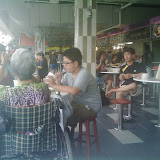 |
| Kopitiam Sengkang |
Tuesday, December 22, 2009
The voices of the few
If there is one thing about Singapore above all else, it must be the raw efficiency of the place, and I don't mean that in a positive manner. Take for example the night market in Changi Village. It has reportedly ceased operations from 19th December 2009, after being there for well over a year. And the reasons given for the forced closure?
1. Visitors' vehicles are parked indiscriminately along the short and narrow roads, thus contributing to congestion. The question is, how come it took all of 18 months to effect the solution (i.e. close the night market). Was the problem that serious? And I thought the obvious solution rather is to issue parking tickets, not close the market? You'd apply ointment to a wounded finger, not chop it off? But the local Singapore authorities can be ruthless and efficient, if a little late. Just chop off the damn thing!
2. Shopkeepers complain that businesses is being taken away from them. Question: ditto above. How come it took all of 18 months to bleed business before the solution (i.e. close the night market) was implemented? (NB: Shopkeepers that the press spoke to insist that the night market has actually been GOOD for their businesses, having driven human traffic to that sleepy corner of the island.) So who/which businesses complained? How many of them?
So the one big mystery that is begging an answer: Why was the night market shut down? What exactly was the complaint? What has been done in the last one year to address the complaints before it was decided that this drastic action was the only solution?
Transparency on this island? Hardly.
I used to visit this part of the island. Sadly, there is one less reason to do so now.
1. Visitors' vehicles are parked indiscriminately along the short and narrow roads, thus contributing to congestion. The question is, how come it took all of 18 months to effect the solution (i.e. close the night market). Was the problem that serious? And I thought the obvious solution rather is to issue parking tickets, not close the market? You'd apply ointment to a wounded finger, not chop it off? But the local Singapore authorities can be ruthless and efficient, if a little late. Just chop off the damn thing!
2. Shopkeepers complain that businesses is being taken away from them. Question: ditto above. How come it took all of 18 months to bleed business before the solution (i.e. close the night market) was implemented? (NB: Shopkeepers that the press spoke to insist that the night market has actually been GOOD for their businesses, having driven human traffic to that sleepy corner of the island.) So who/which businesses complained? How many of them?
So the one big mystery that is begging an answer: Why was the night market shut down? What exactly was the complaint? What has been done in the last one year to address the complaints before it was decided that this drastic action was the only solution?
Transparency on this island? Hardly.
I used to visit this part of the island. Sadly, there is one less reason to do so now.
Monday, December 21, 2009
That Lie
Marina Bay Sands Singapore is supposed to have opened its doors for business this month. That was the original plan, but we all know that plans can change, and in the case of the Marina Bay Sands Singapore (aka Hotel and Casino Resort), the revised opening date is some time in April 2010 though some say that June 2010 is a more realistic date.
April, when April Fools' day falls, is probably not an ideal month to open a Casino, from the gamblers' perspective. But it'll probably be roaring business of a casino though because gamblers are by nature risk takers, fools or not. These revision in schedules show up the lie in the whole Integrated Resort (IR) message. When Singapore went ahead with setting up not one but two casinos, the government insisted that it wasn't casinos per se, but an integration of various entertainment and convention businesses (MICE) that were on the cards, that Singapore isn't transforming itself into a Las Vegas of the East. Casinos were just to be a small part of the whole development. But the latest developments (or probably non-developments) has given the lie to this claim.
When push comes to shove, and it is time for payback. the only most immediately profitable business that must be opened first is the casino. So come April or June next year, or whatever month it eventually opens, the casino business must precede all others. The business / conventions / meeting / entertainment events? Well, they are not Marina Bay Sands' priority, really. From recouping the money point of view (more than S$5 Billion), the casino business is the one and only bet on the table, never mind what the government says about having 50% of the other businesses in place as a condition for the casinos to start operations. But then, starting the casino first makes sense. Nobody would want to have a major meeting event there, or go shopping, and least of all, go there for a stroll when half of the place is still under construction. The dust and dirt will be an instant turnoff. Orchard Road will still be a cooler place to go to, in more ways than one. But gambling? Hey the dirt doesn't matter. When gambling can take place in a back alley as much as it can in a swanky hotel, it is the only sensible thing to do - take the money and run.
So if we want to call a spade a spade, we should just admit that Singapore is close to becoming the betting capital of this part of the world. The rest are just sideshows. The problem is, with the government's liberal policies on immigration, will it attract the 'right' people to this island in the long run? It would appear that climate change is the least of our worries.
April, when April Fools' day falls, is probably not an ideal month to open a Casino, from the gamblers' perspective. But it'll probably be roaring business of a casino though because gamblers are by nature risk takers, fools or not. These revision in schedules show up the lie in the whole Integrated Resort (IR) message. When Singapore went ahead with setting up not one but two casinos, the government insisted that it wasn't casinos per se, but an integration of various entertainment and convention businesses (MICE) that were on the cards, that Singapore isn't transforming itself into a Las Vegas of the East. Casinos were just to be a small part of the whole development. But the latest developments (or probably non-developments) has given the lie to this claim.
When push comes to shove, and it is time for payback. the only most immediately profitable business that must be opened first is the casino. So come April or June next year, or whatever month it eventually opens, the casino business must precede all others. The business / conventions / meeting / entertainment events? Well, they are not Marina Bay Sands' priority, really. From recouping the money point of view (more than S$5 Billion), the casino business is the one and only bet on the table, never mind what the government says about having 50% of the other businesses in place as a condition for the casinos to start operations. But then, starting the casino first makes sense. Nobody would want to have a major meeting event there, or go shopping, and least of all, go there for a stroll when half of the place is still under construction. The dust and dirt will be an instant turnoff. Orchard Road will still be a cooler place to go to, in more ways than one. But gambling? Hey the dirt doesn't matter. When gambling can take place in a back alley as much as it can in a swanky hotel, it is the only sensible thing to do - take the money and run.
So if we want to call a spade a spade, we should just admit that Singapore is close to becoming the betting capital of this part of the world. The rest are just sideshows. The problem is, with the government's liberal policies on immigration, will it attract the 'right' people to this island in the long run? It would appear that climate change is the least of our worries.
Wednesday, December 16, 2009
Ballshit
Here we go again. This time, the really big one, the mother of all ball games - the 2010 Fifa World Cup South Africa next year, no less. (Sheesh, that phrase is trademarked). What event can be bigger than that for a world crazy about 11x2 (minus the occasional red carded) people kicking an inflated rubber ball around a rectangular field?
And to fit the size of the event, Fifa, the world football governing body, has seen fit to extract that pound of flesh from the very people that give life to this activity. In Singapore, the main broadcast providers, Singtel and Starhub, have very sensibly colluded to get the best deal they can from the licensing people in Fifa. Yet even this collusion might not guarantee a sensible price at which armchair footballers might be willing to cough up. I hear that Fifa is expecting everyone to serve up an arm and a leg for the rights to broadcast the World Cup matches. Talk about profiteering. The price for watching club football in Britain's EPL is bad enough. They routinely also extract that pound of flesh for broadcast rights, which football crazy fans so willingly offer on the altar of the mother of all balls. I suppose Fifa has wised up to the game and wants in too. The colour of money excites more than balls, stupid! What they will do with that money is beyond me. Maybe fly first class to any and all meetings around the world to start with. They say money corrupts. Are we witnessing the beginning of the fall of soccer once the greed sets into every part (read: people) of the game? Well, ok, they did SAY they will donate the proceeds, but when you cause pain to countless so that you can appear generous to some...I am not so sure where the charitable spirit lies...(Hmmm...I wonder if Fifa's accounts are audited, and if so, by whom?)
Many say soccer is the beautiful game. Well, I agree. Its a beautifully 'green' game, and I don't mean environmentally friendly. I can see where some people can spot the beauty in the game. Soon the officials will be so swamp with the cash that they wouldn't even care what a ball looks like, or care if it is made of bullshit, much less what to do with it (handle it? - yeah this is accepted in FOOTball nowadays - the rote has set in, led by some of the world's best footballers like Diego Maradona and Thierry Henri, who win matches with their hands, whether sanctioned by God or not).
So when this happens, people will be knocked to their senses to see how they have been fooled all these many years into coughing up blood money to people who just kick a ball (and handle it once a while) and people who just organise these kicking ballfests.
Have the rest of us humans become so dumb that we willlingly let others swindle us in broad daylight? Yeah, blame the balls.
And to fit the size of the event, Fifa, the world football governing body, has seen fit to extract that pound of flesh from the very people that give life to this activity. In Singapore, the main broadcast providers, Singtel and Starhub, have very sensibly colluded to get the best deal they can from the licensing people in Fifa. Yet even this collusion might not guarantee a sensible price at which armchair footballers might be willing to cough up. I hear that Fifa is expecting everyone to serve up an arm and a leg for the rights to broadcast the World Cup matches. Talk about profiteering. The price for watching club football in Britain's EPL is bad enough. They routinely also extract that pound of flesh for broadcast rights, which football crazy fans so willingly offer on the altar of the mother of all balls. I suppose Fifa has wised up to the game and wants in too. The colour of money excites more than balls, stupid! What they will do with that money is beyond me. Maybe fly first class to any and all meetings around the world to start with. They say money corrupts. Are we witnessing the beginning of the fall of soccer once the greed sets into every part (read: people) of the game? Well, ok, they did SAY they will donate the proceeds, but when you cause pain to countless so that you can appear generous to some...I am not so sure where the charitable spirit lies...(Hmmm...I wonder if Fifa's accounts are audited, and if so, by whom?)
Many say soccer is the beautiful game. Well, I agree. Its a beautifully 'green' game, and I don't mean environmentally friendly. I can see where some people can spot the beauty in the game. Soon the officials will be so swamp with the cash that they wouldn't even care what a ball looks like, or care if it is made of bullshit, much less what to do with it (handle it? - yeah this is accepted in FOOTball nowadays - the rote has set in, led by some of the world's best footballers like Diego Maradona and Thierry Henri, who win matches with their hands, whether sanctioned by God or not).
So when this happens, people will be knocked to their senses to see how they have been fooled all these many years into coughing up blood money to people who just kick a ball (and handle it once a while) and people who just organise these kicking ballfests.
Have the rest of us humans become so dumb that we willlingly let others swindle us in broad daylight? Yeah, blame the balls.
Saturday, November 28, 2009
Juvenile Depiction
Singapore will be present in the 2010 Shanghai World Expo - an event that will put the stamp on China as one of the, if not, THE leading economic power in the world today. Yesterday, Health Minister Khaw Boon Wah unwield Singapore's contribution to this World Expo. Among these is the Singapore Pavilion Mascot, named Liu Lian Xiao Xing, or "Durian Star,". I was aghast at the life-sized figure of this mascot:

The first thing that came to mind was the defaced painting of Whistler's Mother, in Mr Bean (1997), in which Mr Bean (Rowan Atkinson) defaced a painting in the Royal British Gallery:

The juvenile face of the Durian Star mascot resembled the one that Mr Bean drew over that famous painting. And that Merlion picture on the chest is equally juvenile. Well, any 5 year-old child could have drawn that face and even the Merlion! I was embarrassed. Is this the best that Singapore can come up with for a mascot in a World Expo? I don't know whether it was a lack of funds in the Singapore government's coffers, of a lack of imagination, or a lack talent or what, but to employ a 5 year-old kid to draw the face of Durian Star is just too, err, juvenile. They might as well ask Mr Bean to draw it. What would the world think of Singapore at the Shanghai World Expo? That we are after all a Durian Republic?
And the durian isn't even a national fruit or anything. Durian, if I am not mistaken, originates from Borneo (East Malaysia) and Sumatra. Over the years, it has spread to other parts of the Malay Peninsula, Thailand and the Philippines. Granted Singapore is geographically part of the Malay Peninsula, and its people love eating the fruit, but it still doesn't make durian its own. We do have the Esplanade Theatres 'Durian' on (sic) the Bay, but the building still doesn't make it any more Singaporean because it is shaped like a durian.
Malaysia once tried to stake its claim on certain foods, to copyright them even. It was a silly idea, everyone panned it, and it wasn't taken seriously. But hey, they may try to stake their copyright on 'their' fruits too, even if the foods failed. Then we will have a problem with going ahead with our mascot, if Malaysia raises a ruckus during the World Expo. We might even have to shave off the pointed parts of the durian and rename the mascot 'Pointless Star', or simply 'botak'.
Are our designers bereft of any ideas?

The first thing that came to mind was the defaced painting of Whistler's Mother, in Mr Bean (1997), in which Mr Bean (Rowan Atkinson) defaced a painting in the Royal British Gallery:

The juvenile face of the Durian Star mascot resembled the one that Mr Bean drew over that famous painting. And that Merlion picture on the chest is equally juvenile. Well, any 5 year-old child could have drawn that face and even the Merlion! I was embarrassed. Is this the best that Singapore can come up with for a mascot in a World Expo? I don't know whether it was a lack of funds in the Singapore government's coffers, of a lack of imagination, or a lack talent or what, but to employ a 5 year-old kid to draw the face of Durian Star is just too, err, juvenile. They might as well ask Mr Bean to draw it. What would the world think of Singapore at the Shanghai World Expo? That we are after all a Durian Republic?
And the durian isn't even a national fruit or anything. Durian, if I am not mistaken, originates from Borneo (East Malaysia) and Sumatra. Over the years, it has spread to other parts of the Malay Peninsula, Thailand and the Philippines. Granted Singapore is geographically part of the Malay Peninsula, and its people love eating the fruit, but it still doesn't make durian its own. We do have the Esplanade Theatres 'Durian' on (sic) the Bay, but the building still doesn't make it any more Singaporean because it is shaped like a durian.
Malaysia once tried to stake its claim on certain foods, to copyright them even. It was a silly idea, everyone panned it, and it wasn't taken seriously. But hey, they may try to stake their copyright on 'their' fruits too, even if the foods failed. Then we will have a problem with going ahead with our mascot, if Malaysia raises a ruckus during the World Expo. We might even have to shave off the pointed parts of the durian and rename the mascot 'Pointless Star', or simply 'botak'.
Are our designers bereft of any ideas?
Saturday, November 21, 2009
A Serious Flood?
Sometimes you wonder about the reasoning that comes out of the government's mouth. Referring to the deluge that many parts of Singapore faced on Thursday afternoon, Environment and Water Resources Minister Yaacob Ibrahim was reported to have said that this kinds of deluge (rain) happens only once in 50 years. Well it happened yesterday, in the year 2009. According to his estimate, the next deluge of this size isn't due till 2059. So I am puzzled why the Public Utilities Board (PUB) wants to upgrade Bukit Timah's first diversion canal, which was built in the 1970s to alleviate the then flood-prone area. It has proved to be effective all these many years, except last Thursday, which as Dr Yaacob Ibrahim explained, was a rare occurrence.
Or is the PUB not letting on something? If so, then could Thursday's deluge have been prevented in the first place, or was somebody sleeping on the job. It has had to take a severe act of God to wake up our overworked(?) civil servants?
I was surprised that a wide expanse of that Bukit Timah area was flooded. Ever since the early 1980s, where floods still occurred, it has never happened again, thanks to the civil works to widen the canal and making sure that the waters flowed into our rivers unimpeded. I know, because I once had to wade, knee-deep, to make it to school there, and that was 1981.
Looks like Singapore needs to do some more digging, of a different sort that Minister Raymond Lim is familiar with. It needs to make sure that the same flooding will not occur again. But then, going by PUB's account, that wouldn't be 50 years hence. There's all the time in the world!
Or is the PUB not letting on something? If so, then could Thursday's deluge have been prevented in the first place, or was somebody sleeping on the job. It has had to take a severe act of God to wake up our overworked(?) civil servants?
I was surprised that a wide expanse of that Bukit Timah area was flooded. Ever since the early 1980s, where floods still occurred, it has never happened again, thanks to the civil works to widen the canal and making sure that the waters flowed into our rivers unimpeded. I know, because I once had to wade, knee-deep, to make it to school there, and that was 1981.
Looks like Singapore needs to do some more digging, of a different sort that Minister Raymond Lim is familiar with. It needs to make sure that the same flooding will not occur again. But then, going by PUB's account, that wouldn't be 50 years hence. There's all the time in the world!
Saturday, November 14, 2009
Calling all NBasers
A Dr Loh Kah Seng of the ISEAS is doing research on the British Bases and military withdrawal from Singapore in the 1970s. I reproduce his letter and invitation to contribute, addressed to fellow Singaporeans, regarding this research:
-quote-
Dear fellow Singaporeans
I am a Singaporean historian looking to speak to people who remember the British bases and their withdrawal in the early 1970s. The withdrawal was the first major crisis independent Singapore faced. The 56 bases, contributing a fifth of the country’s GDP, were its largest industry, and the pullout threatened the livelihood of one-sixth of the labour force, including an estimated 8,000 amahs.
The pullout also transformed the economy, society and landscape of Singapore in the 1970s. Most of the bases were converted to commercial use, while many base workers underwent a 3-month retraining crash course. Technical and vocational education also expanded, as new laws sought to increase labour productivity and attract foreign capital investment.
These developments resonate with us today: the retraining programmes, the mobilisation of the young, the philosophy that ‘no one owes Singapore a living’. There is also a forgotten social history to unearth: how retrenched base employees coped with the crisis and how workers adjusted to new work routines.
If you remember the British bases and rundown, or have a family member, relative or friend who does, kindly contact me to lend your voice to an important episode of our national story.
Please pass this message along to those who might be interested.
Thank you.
Loh Kah Seng (Dr)
Visiting Research Fellow
Institute of Southeast Asian Studies, Singapore
Email: LKSHIS@GMAIL.COM
- unquote -
You can also go to Dr Loh's blog: http://lkshistory.wordpress.com/
-quote-
Dear fellow Singaporeans
I am a Singaporean historian looking to speak to people who remember the British bases and their withdrawal in the early 1970s. The withdrawal was the first major crisis independent Singapore faced. The 56 bases, contributing a fifth of the country’s GDP, were its largest industry, and the pullout threatened the livelihood of one-sixth of the labour force, including an estimated 8,000 amahs.
The pullout also transformed the economy, society and landscape of Singapore in the 1970s. Most of the bases were converted to commercial use, while many base workers underwent a 3-month retraining crash course. Technical and vocational education also expanded, as new laws sought to increase labour productivity and attract foreign capital investment.
These developments resonate with us today: the retraining programmes, the mobilisation of the young, the philosophy that ‘no one owes Singapore a living’. There is also a forgotten social history to unearth: how retrenched base employees coped with the crisis and how workers adjusted to new work routines.
If you remember the British bases and rundown, or have a family member, relative or friend who does, kindly contact me to lend your voice to an important episode of our national story.
Please pass this message along to those who might be interested.
Thank you.
Loh Kah Seng (Dr)
Visiting Research Fellow
Institute of Southeast Asian Studies, Singapore
Email: LKSHIS@GMAIL.COM
- unquote -
You can also go to Dr Loh's blog: http://lkshistory.wordpress.
Saturday, October 24, 2009
Cheap cheap
Everyone, I suppose, in Singapore knows that medicine across the Causeway is cheaper, just like food and petrol. So it is natural that Singaporeans exit Singapore in droves during weekends to stretch their feet and their Singapore Dollar. Over the years, however, Johor has become less of a shopper's paradise for Singaporeans. For some time now, the prices in their shopping malls aren't too different from what you can get back in Singapore.
Petrol is still a bargain, but the Singapore government does its best to 'pursuade' Singaporeans to 'buy Singapore'. The 3 Qtr tank rule is still there. However, of late, the powers that be appears to have changed their minds. For example, Health Minister Khaw Boon Wan has famously said (in February 2009) that Singaporeans can consider putting their elderly parents in Nursing Homes in Johore. Now, Salma Khalik, ST's Health Correspondent (who reported on the Johore Nursing Home story earlier this year for the same paper) is suggesting that Singaporeans stretch their dollar by getting vaccination jabs (against streptococcus pneumoniae bacteria) in Malaysia simply because it costs much less there than in Singapore. Although Mr Khaw's name is missing in this opinion piece, it is pretty much the same point that Mr Khaw was making - there are choices for cheaper medicine, and Singaporean's should avail themselves of it, never mind that you can't avail yourself of more than a quarter tank of cheaper petrol over there. I suppose the petrol is not Mr Khaw's department. The Transport Minister, Mr Raymond Lim doesn't seem to have heard, nor is willing to hear, or if heard, is not willing to have a change of heart about Singaporeans having the choice of spending less on petrol.
By now, everybody knows that medicine in Singapore isn't cheap. That is common knowledge, really. There is a perception that, on the whole, medicine is good in Singapore. That's the premium you have to pay. But now Ms Khalik is suggesting (see Straits Time, 23 October 2009, page A2) that medicine in Malaysia, as far as vaccinations go, is just as good, you wonder why you have to continue to pay a premium in Singapore? It would appear that not only do our businesses price themselves out of the market that lead to the inevitable recessionary cycle, we, the citizens of Singapore, also get priced out of our products like medicine, which isn't exactly optional in our lives. And who are setting the prices in the medical sector in Singapore? Go figure.
I suppose we have to thank Ms Khalik for her money-saving tip, but we would also be grateful if somebody were to talk to Minister Raymond Lim about that petrol thingy.
Petrol is still a bargain, but the Singapore government does its best to 'pursuade' Singaporeans to 'buy Singapore'. The 3 Qtr tank rule is still there. However, of late, the powers that be appears to have changed their minds. For example, Health Minister Khaw Boon Wan has famously said (in February 2009) that Singaporeans can consider putting their elderly parents in Nursing Homes in Johore. Now, Salma Khalik, ST's Health Correspondent (who reported on the Johore Nursing Home story earlier this year for the same paper) is suggesting that Singaporeans stretch their dollar by getting vaccination jabs (against streptococcus pneumoniae bacteria) in Malaysia simply because it costs much less there than in Singapore. Although Mr Khaw's name is missing in this opinion piece, it is pretty much the same point that Mr Khaw was making - there are choices for cheaper medicine, and Singaporean's should avail themselves of it, never mind that you can't avail yourself of more than a quarter tank of cheaper petrol over there. I suppose the petrol is not Mr Khaw's department. The Transport Minister, Mr Raymond Lim doesn't seem to have heard, nor is willing to hear, or if heard, is not willing to have a change of heart about Singaporeans having the choice of spending less on petrol.
By now, everybody knows that medicine in Singapore isn't cheap. That is common knowledge, really. There is a perception that, on the whole, medicine is good in Singapore. That's the premium you have to pay. But now Ms Khalik is suggesting (see Straits Time, 23 October 2009, page A2) that medicine in Malaysia, as far as vaccinations go, is just as good, you wonder why you have to continue to pay a premium in Singapore? It would appear that not only do our businesses price themselves out of the market that lead to the inevitable recessionary cycle, we, the citizens of Singapore, also get priced out of our products like medicine, which isn't exactly optional in our lives. And who are setting the prices in the medical sector in Singapore? Go figure.
I suppose we have to thank Ms Khalik for her money-saving tip, but we would also be grateful if somebody were to talk to Minister Raymond Lim about that petrol thingy.
Saturday, October 10, 2009
Heavenly house
Housing people in Singapore has been a challenge. It always has been, and probably will continue to be. Back in the early days - the 1960s/70s, it was building enough public housing apartments fast enough. Today, it is trying to put people into their preferred houses fast enough - high floors, not situated in some remote and god-forsaken corner of the island, near where their parents live, has a full suite of amenities - wet markets, supermarkets, shopping mall, adequate parking, schools (the more well-known ones the better), convenient public transport (bus, MRT, LRT), has a view, preferably of the sea, or at least some greenery, etc. etc.
You can never satisfy all of them, but can you blame people with this laundry list of demands when the price of a public housing apartment these days is upwards of S$200,000? In some countries, you can get a bungalow for that kind of money. The government does not seem to get it. I think anybody will be happy with any public apartment if the prices weren't so stratospheric. But when you are potentially tied down for the rest of your life servicing the mortgage, you'd naturally want something better. Frankly, whatever subsidy that the government provides for nowadays is "peanuts", to quote a distinguished citizen. No, it wouldn't be practical to have all the items on the laundry list checked off, but you try to get the best. And this is why, I suppose, some people reject apartments offered to them time and again.
Having said that, however, people should look at the practical side of things. When it is your first apartment with your fiance/wife, take any flat that is offered, even if it is in the most remote corner of the island. Someone said that Punggol is in one corner of the island (read "remote"). Singapore is a small island, and no part of the island that is remote today will remain so tomorrow. The reason why our parents made so much money from their public apartment over the years is because of this belief. They didn't mind Toa Payoh when it was a swamp-land, ditto Ang Mo Kio, Bishan, etc. With the redevelopment of the surrounding land courtesy of the government, the value of the real estate naturally soared. Many cashed out and moved to more virgin parts of the island to repeat their conquests of new land and more value. Sure, you need to put up with the inconvenience at first, and probably the sneers and jokes from relatives and friends about your living in an ulu place, but you probably will have the last laugh when you cash out again and buy that dream condo, and then have something left over for a good meal of curry fish-head.
The value of your apartment may not appreciate as much today compared to 15-25 years ago, but property will always be valuable in land-scarce Singapore. If the government wants to build apartments in a particular part of the island, you can be sure that they already have big plans for redeveloping that piece of land and its surroundings. Don't be short-sighted and go for instant gratification. Every good investor will tell you the same. Isn't a house an investment rather than an expense?
You can never satisfy all of them, but can you blame people with this laundry list of demands when the price of a public housing apartment these days is upwards of S$200,000? In some countries, you can get a bungalow for that kind of money. The government does not seem to get it. I think anybody will be happy with any public apartment if the prices weren't so stratospheric. But when you are potentially tied down for the rest of your life servicing the mortgage, you'd naturally want something better. Frankly, whatever subsidy that the government provides for nowadays is "peanuts", to quote a distinguished citizen. No, it wouldn't be practical to have all the items on the laundry list checked off, but you try to get the best. And this is why, I suppose, some people reject apartments offered to them time and again.
Having said that, however, people should look at the practical side of things. When it is your first apartment with your fiance/wife, take any flat that is offered, even if it is in the most remote corner of the island. Someone said that Punggol is in one corner of the island (read "remote"). Singapore is a small island, and no part of the island that is remote today will remain so tomorrow. The reason why our parents made so much money from their public apartment over the years is because of this belief. They didn't mind Toa Payoh when it was a swamp-land, ditto Ang Mo Kio, Bishan, etc. With the redevelopment of the surrounding land courtesy of the government, the value of the real estate naturally soared. Many cashed out and moved to more virgin parts of the island to repeat their conquests of new land and more value. Sure, you need to put up with the inconvenience at first, and probably the sneers and jokes from relatives and friends about your living in an ulu place, but you probably will have the last laugh when you cash out again and buy that dream condo, and then have something left over for a good meal of curry fish-head.
The value of your apartment may not appreciate as much today compared to 15-25 years ago, but property will always be valuable in land-scarce Singapore. If the government wants to build apartments in a particular part of the island, you can be sure that they already have big plans for redeveloping that piece of land and its surroundings. Don't be short-sighted and go for instant gratification. Every good investor will tell you the same. Isn't a house an investment rather than an expense?
Sunday, October 04, 2009
EPL ransom
It is news that didn't bother me at all, but it has got quite a number of people in Singapore upset yet resigned over it. No, it isn't about the local S-League that has come up for criticism from one of its own. It definitely is not about Ris Low, nor the revivied mini-bonds saga. It wasn't the earthquake in Sumatra, which shook many Singaporean's out of their highrises. No, its is about the most important thing in many people's lives in Singapore today - watching the English Premier League (EPL) games 'live' on TV.
Many were upset to learn that their erstwhile provider for EPL broadcasts, Starhub, has lost its broadcasting rights to rival Singtel. Just when they were settling down on the skyhigh prices that Starhub currently charges, they are faced with the propect of paying more in a year's time. As both operate the transmission of their programmes using different platforms, die-hard fans will have to invest on both platforms - cable and mio, or give up their cable (Starhub) equipment in exchange for Singtel's mio. Such is the grief that honest but desperate consumers have to suffer from big businesses trying to hook them in. But why are these broadcast rights so expensive?
It is business. If Singtel thinks that it can 'extort' the kind of money it will probably charge viewers of these programmes, and these die-hard fans are willing to shell out that kind of money, then its a willing buyer willing seller situation. Well, Singtel did say that it will not charge more than what Starhub charges now, even though the amount of Singtel's bid is reportedly twice what Starhub paid (i.e. US$160m) when it secured the rights in 2007.
Whatever Singtel will charge is not important to me. What is important is that they don't go off and start cross-subsidizing their services, and recover the costs of the EPL license from non-viewers like me. Charge whatever you need to charge soccer-mad fans for their fix, but don't increase the prices of other services, such as mobile and fixed-line services. I am not a soccer fan and I do not want to pay for Singtel's madness, and those EPL soccer fans as well. If they find joy in contributing to the overpaid soccer players in the EPL, that's their pleasure and their right. I do not want to be a part of it.
Otherwise, I am sure MDA, or someone with a big stick, will look into it.
Many were upset to learn that their erstwhile provider for EPL broadcasts, Starhub, has lost its broadcasting rights to rival Singtel. Just when they were settling down on the skyhigh prices that Starhub currently charges, they are faced with the propect of paying more in a year's time. As both operate the transmission of their programmes using different platforms, die-hard fans will have to invest on both platforms - cable and mio, or give up their cable (Starhub) equipment in exchange for Singtel's mio. Such is the grief that honest but desperate consumers have to suffer from big businesses trying to hook them in. But why are these broadcast rights so expensive?
It is business. If Singtel thinks that it can 'extort' the kind of money it will probably charge viewers of these programmes, and these die-hard fans are willing to shell out that kind of money, then its a willing buyer willing seller situation. Well, Singtel did say that it will not charge more than what Starhub charges now, even though the amount of Singtel's bid is reportedly twice what Starhub paid (i.e. US$160m) when it secured the rights in 2007.
Whatever Singtel will charge is not important to me. What is important is that they don't go off and start cross-subsidizing their services, and recover the costs of the EPL license from non-viewers like me. Charge whatever you need to charge soccer-mad fans for their fix, but don't increase the prices of other services, such as mobile and fixed-line services. I am not a soccer fan and I do not want to pay for Singtel's madness, and those EPL soccer fans as well. If they find joy in contributing to the overpaid soccer players in the EPL, that's their pleasure and their right. I do not want to be a part of it.
Otherwise, I am sure MDA, or someone with a big stick, will look into it.
Friday, October 02, 2009
Abused Beauty
After all is said and done, I think Singaporeans have been a bit mean (well, ok, very mean) to Ms Ris Low. Much has been said and written about her less than perfect English diction and videos have made her the laughing stock of the whole country. Why are we so mean? It is not as if she is totally unintelligble when she speaks. I can think of and heard other Singaporeans pronounce English words the way she does. Just today I was at a seminar presented by a major public-listed company, in a room full of professionals, and its speakers were pronouncing 'badder' for 'better'. There were a couple of other words that were similarly abused. This isn't all that different from Ms Low's diction. In this respect, I think some of the Youtube videos about her less than perfect diction have been made in bad taste. Yes, they are funny, but they are also very cruel. In fact, unless Mediacorp (or whoever the original video belongs to) is in on it, some IP rights may have been violated and the perpetrators could be charged in Court. What's the difference then between Ms Low's trouble with the law with this sort of 'stealing'? So whoever put them up should take them down.
And what's wrong with Boomz? At least now English has a new word, and words are created all the time. Singlish has produced not a few of them, which we have come to love. We don't understand what Boomz is? Well, neither do I understand what the 'lah' that ends Singlish phrases mean. But don't we use it with relish because that is so Singaporean? That's one thing you look out for when you are overseas, when in a sea of people, it brings a smile to your face the moment you hear it. You know for sure that a countryman is in the midst. Lewis Carroll himself was probably 'guilty' of spouting nonsense, with his invention of the nonsensical words 'jabberwocky', 'chortled and 'galumping' in his poems. But these words have since entered the English language. OK, ok, Ms Low was not being particularly poetic when she blurted out the Boomz word. But inventions are often made at the spur of the moment, no?
But isn't the whole of Singapore, in ridiculing it, now trying to give meaning to the word? In time, who knows, it may become a peculiar Singlish word that our children will use without the ridicule that accompanies it today.
I think the real 'problem' is not her language, nor particularly her diction. If it were, many Singaporean's will be just as guilty as her. Her diction could have been 'badder', as befits the representative of Singapore women, but I think the real issue about her representing Singapore is her conviction for credit card fraud. She should have come clean about it from the start. Unfortunately, she did not. Maybe she was immature, maybe she thought that her achievements in the beauty pageant will erase her 'moment' of weakness (well, that moment did last quite a while, I admit). But I think enough is enough. Let the poor girl alone. Hopefully she has learnt the right lessons from the whole affair and we will hear better things of her in the future.
Boomz! RIP.
And what's wrong with Boomz? At least now English has a new word, and words are created all the time. Singlish has produced not a few of them, which we have come to love. We don't understand what Boomz is? Well, neither do I understand what the 'lah' that ends Singlish phrases mean. But don't we use it with relish because that is so Singaporean? That's one thing you look out for when you are overseas, when in a sea of people, it brings a smile to your face the moment you hear it. You know for sure that a countryman is in the midst. Lewis Carroll himself was probably 'guilty' of spouting nonsense, with his invention of the nonsensical words 'jabberwocky', 'chortled and 'galumping' in his poems. But these words have since entered the English language. OK, ok, Ms Low was not being particularly poetic when she blurted out the Boomz word. But inventions are often made at the spur of the moment, no?
But isn't the whole of Singapore, in ridiculing it, now trying to give meaning to the word? In time, who knows, it may become a peculiar Singlish word that our children will use without the ridicule that accompanies it today.
I think the real 'problem' is not her language, nor particularly her diction. If it were, many Singaporean's will be just as guilty as her. Her diction could have been 'badder', as befits the representative of Singapore women, but I think the real issue about her representing Singapore is her conviction for credit card fraud. She should have come clean about it from the start. Unfortunately, she did not. Maybe she was immature, maybe she thought that her achievements in the beauty pageant will erase her 'moment' of weakness (well, that moment did last quite a while, I admit). But I think enough is enough. Let the poor girl alone. Hopefully she has learnt the right lessons from the whole affair and we will hear better things of her in the future.
Boomz! RIP.
Subscribe to:
Posts
(
Atom
)